
29 Steps or 3 Outcomes?
Rethinking skill in police training.

Publication
O’Neill, J., O’Neill, D.A., Weed, K. et al. Police Academy Training, Performance, and Learning. Behav Analysis Practice 12, 353–372 (2019). https://doi.org/10.1007/s40617-018-00317-2
What Was the Question?
O’Neill et al. (2019) asked how different approaches to teaching defensive tactics in police academies affect cadet performance, learning, and retention. While most academies rely on block-style, “check-the-box” training, little empirical work had been done to measure actual skill performance or how well training outcomes are maintained over time. The authors set out to evaluate training practices across three academies and to explore whether behavior-analytic methods (task analysis, objective scoring, follow-ups, booster sessions) could provide more rigorous evidence of training effectiveness.
How Did They Look at It?
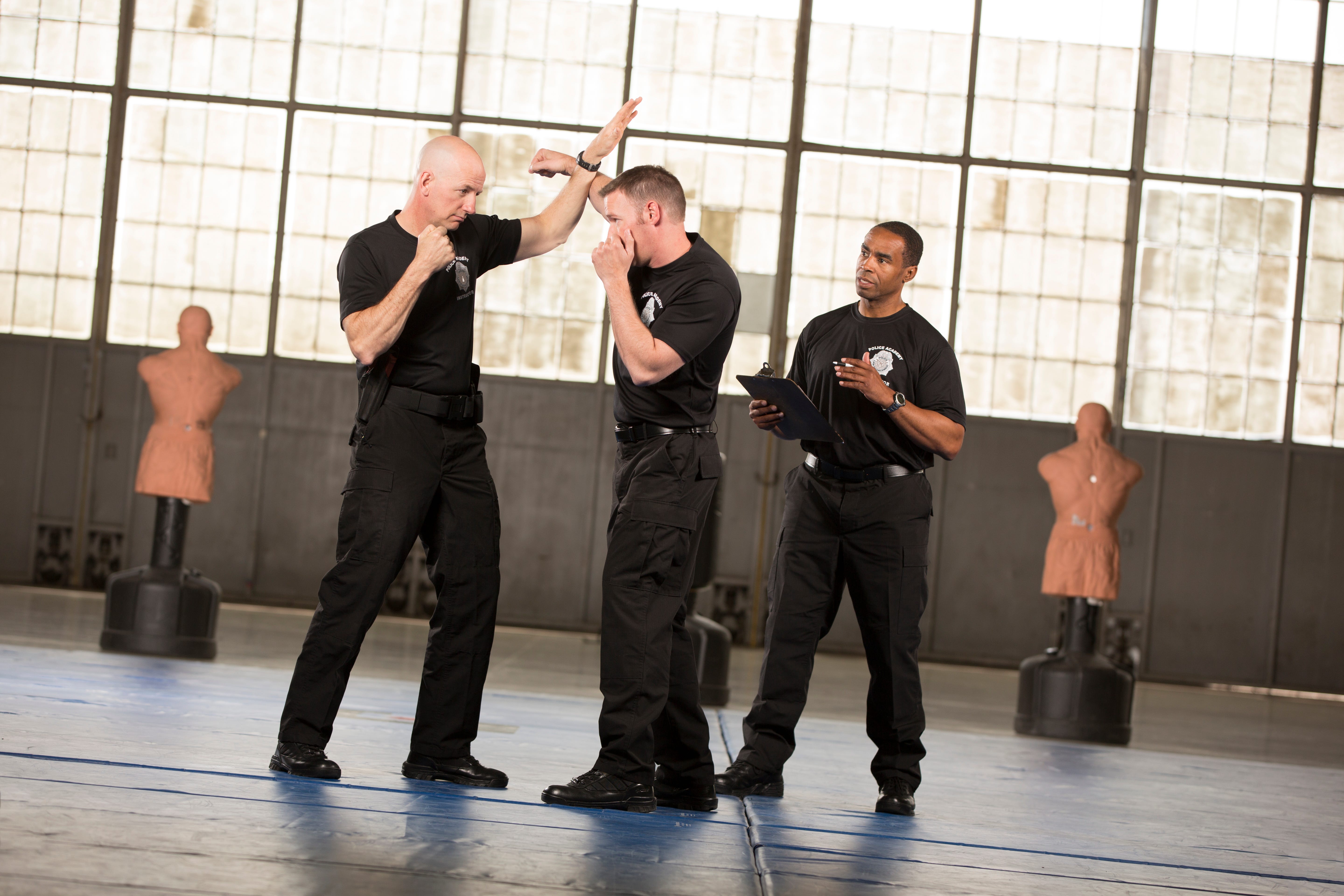
The study involved three experiments conducted at three large regional police academies located across the U.S. All training sessions in all of the studies involved expert trainers demonstrating and explaining the technique to the students who would then try to imitate the instructor. All participants were actual academy students and all techniques were drawn from the techniques that the academies currently taught.
1. Experiment 1: Examined the effects of block training (where all training on a particular skill is done in one session) on two tactics (mandibular pressure point and firearm disarming). The participants received 22 minutes of training in the mandibular pressure point and 49 Minutes for the disarming technique. The design included a pretest, a posttest, and retention tests at 1, 2, 4, and 8 weeks.
2. Experiment 2: Tested spaced sessions where the participants received training in a skill that was spaced out in time. The skill tested was a particular handcuffing technique. Participants completed a total of 4 training sessions with the total amount of training time in the technique being 38 minutes. Skill retention tests were conducted at 1, 2, 4, and 8 weeks after training.
3. Experiment 3: Studied block training combined with scenario-based feedback on a disarming technique and a baton strike to the common peroneal nerve. The initial training sessions for the disarming technique was 29 minutes. For the baton strike the initial training was 54 minutes. The scenario based training only tested the disarming technique and was conducted 3 weeks after the students received the training session. The scenario involved about 11 minutes of refresher training in the disarm technique and the scenario included a situation where the disarm technique was needed to resolve the situation. Retention testing of the disarm technique was conducted at 7 and 15 weeks following disarm training and 10 and 18 weeks after the baton training.
In all cases, cadets’ performance was measured using a tightly designed task analyses scored from video. This task analysis broke each technique into between 12 and 31 sub-steps that were coded as present or absent for each student on each test. These sub-steps were very specific about stances, distances, and precise actions. Confidence and practice outside training were also surveyed.
What Did They Find?
Regardless of how the training was conducted, the researchers found large initial training effects. Participants did much better on the initial posttests than they did on the pretests. This is not surprising because many of the students had no idea what was being asked of them on the pretest.
Students did not retain skills well without reinforcement. Performance consistently declined at retention checks.
Spaced training insulated against this decline. More distributed training (Experiment 2) supported retention maintenance more than single block sessions.
Confidence and performance were not strongly related. Cadets reported feeling confident even when their measured performance was modest, showing a mismatch between perception and ability.
So What?
The researchers argue that this study provides some of the first objective, behavior-analytic evidence about how police academy training actually works in practice. The findings underscore that current block-style training is insufficient for long-term skill retention and may leave officers underprepared for real-world encounters. Spaced practice, scenario-based feedback, and instructor use of performance data can significantly improve learning outcomes but require structural changes to academy scheduling and pedagogy.
The authors also note that students did not receive much training in any given skill. The academies each had more than 100 specific defensive tactics that they taught their students. Each academy devoted an hour or less per skill, often with too few repetitions, especially for complex tactics.
They also argue that the results reinforce calls for evidence-based training standards rather than one-size-fits-all approaches. Without ongoing practice and reinforcement, officers risk losing ability in defensive tactics, which may increase reliance on higher levels of force in the field. Future research should isolate behavioral components (e.g., modeling, feedback timing, variable practice) and test their effects systematically.
My $.02
First, I want to recognize how much effort it took to pull off this research project. This was a massive undertaking to organize and execute. Three different academies, hundreds of test videos, it’s rare to see something this ambitious in the literature, and the authors deserve real credit for that.
Second, if you hold to the traditional model of training, this is a textbook example of how to evaluate it. If you believe executing correct techniques is the first step toward mastery, then recording and coding video is a solid way to check performance. They defined sub-steps clearly, scored them as present/absent, and used video so they could review when needed. Pretests, posttests, and retention checks gave a clear picture of how performance shifted over time.
Now, with my EcoD hat on: step-by-step assessments of techniques doesn’t tell you much about skill. Throughout the article, the authors called these skills, but what was taught were techniques—fixed solutions to set problems. Skill is the functional relationship between performer and environment: the ability to adapt movement solutions to achieve goals under shifting constraints. Put simply, technique is memorizing one route on a map. Skill is knowing how to navigate with a compass.
Real skill should be assessed by whether the student achieves the objective in different situations. It doesn’t matter that an officer nails all 29 steps of the “rear disarm.” What matters is three things: they don’t get shot, they take the gun, and they control the suspect. That outcome can unfold in many ways depending on the officer, the suspect, and the environment. The real question isn’t “Was it textbook?” but “Did it work safely, legally, and reliably under pressure?”
Another issue: each academy required cadets to learn over 100 defensive techniques. With the amount of time usually devoted to defensive tactics, each gets less than an hour of practice on average. If many of those techniques have 20 or more sub-steps, we’re asking trainees to memorize, retain, and instantly recall thousands of pieces of information. That’s too many plays in the playbook. It’s not realistic, and it risks clogging decision-making when things get spicy.
In the end, this paper highlights the divide in how we think about skill. If your aim is to see whether cadets can memorize and reproduce steps, this is a solid method. But if your aim is to prepare officers for the chaos of the street, we need to move past steps and scripts. Skill isn’t about stacking 100 techniques—it’s about adapting to the moment and still achieving your goal. That kind of skill isn’t built by perfecting sub-steps. It’s built in scenarios, experienced from day , that force cadets to perceive, decide, and act under pressure. Good training should look messy at first—so that performance in the field doesn’t. Better to be sloppy in training than helpless in the field.
Awesome Article
I have found that participation in contact sports, wrestling and football provided me a set of skills to handle and control a suspect! To the ground for those that resist, for control and handcuffing. Rear neck choke hold works. Weapon retention, etc. The best tool was a 100 lb
German Shepard “ Baron” who literally made all small and large suspect to obey commands!