
High-Powered Assault Rifles?

Publication
Blair, J. P., Sandel, W. L., & Martaindale, M. H. (2021). Correlates of the Number Shot and Killed in Active Shooter Events. Homicide Studies, 25(4), 335-360. https://doi.org/10.1177/1088767920976727
What Was the Issue?
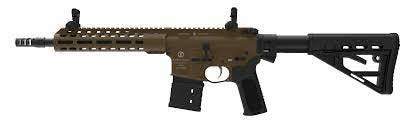
Media coverage of active attacks has focused extensively on the weapons used during attacks. This is especially the case when the weapon used was a “high-powered assault rifle” like the AR-15 (before you start spamming me with comments - I know the AR-15 is not an assault rife). This paper looks at the number of people shot and killed during active shooter events with a focus on the number and types of weapons that were used during the event while statistically controlling for a variety of other variables.
How Did They Look at It?
The authors used the active shooter data developed by the FBI and ALERRT to look at events that occurred between 2000 and 2017. During that time, 250 active shooter events occurred (some of these events were excluded from the analysis because they were statistical outliers). Information on the attacker (age, sex, race, relationship to the attack location), weapons brought to the attack location (total weapons, total rifles, pistols, shotguns, semi-automatic rifles, and other rifles), location (retail, factory, office, outdoors, school, and other), time (year, weekday, daytime), whether the attacker went mobile, and how the event ended (suicide before the police arrived, fled, victims stopped the attacker, police stopped the attacker, and suicide after the police arrived) was coded and entered into several statistical models.
What Did They Find?
Unpacking all the analysis they reported would take too long for this brief summary, so I am just going to focus on a few key points. The first is on the impact of weapons brought to the scene on the number of people shot (because of a lack of detailed information in many cases, the authors were forced to rely on what the attacker brought to the scene instead of the specific weapon used to shoot a particular person).
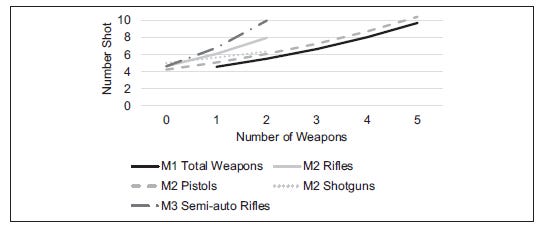
The figure below plots the number of people estimated shot for three different models. In the first model, the total number of weapons that the attacker brought to the scene was entered. The solid dark line shows that as the number of weapons increased, the number of people estimated shot increased. In the second model, the numbers of rifles, pistols, and shotguns brought to the scene were all entered separately. The gray lines in the figure depict the results of this analysis. You can see that the solid gray line has a steeper slope than the dashed line for pistols or the dotted line for shotguns. This indicates that bringing a rifle to the attack was associated with more people being shot than bringing a pistol or shotgun. The dark dot-dash shows the analysis when semi-automatic rifles were separated from other rifles (e.g. bolt action) in the third model (the pistol and shotgun lines were omitted to keep the figure from being too cluttered). This shows the semi-automatic rifles are associated with even more people being shot. It is worth noting that in the included cases, no attacker brought more than 2 rifles to a scene; whereas there were some cases where the attacker brought 5 total weapons or 5 pistols that produced similar predictions for the number of people shot.
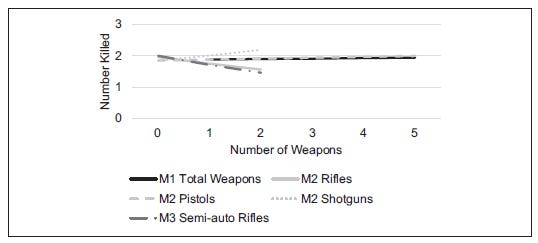
After looking at the number of people shot, the authors also looked at the number of people that were predicted to be killed. These models were done in the same way as the first models, but this time the number of people shot was entered as a control variable along with the other variables. This allowed the authors to look at the lethality of rifles, pistols, and shotguns. The figure below displays these results. It is a little hard to see, but rifle slopes from the different models are all negative indicating that rifles are associated with fewer deaths. Interestingly, shotguns are the only weapon associated with more deaths.
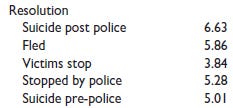
Finally, there were a couple of other interesting findings I wanted to note. When looking at the resolutions, the fewest people were predicted shot when the potential victims stopped the attacker. The predicted number of people shot by how the event ended is below.
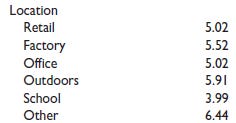
Also schools were associated with fewer people being shot (see the table below) and the number of people predicted killed as been slowly decreasing over time.
So What?
Rifles (particularly semi-automatic rifles) were associated with more people being shot; however, attackers were limited in the number of rifles that they could bring, and attackers bringing 5 pistols were predicted to shoot as many people. At the same time, rifles were associated with fewer people being killed when controlling for the number shot. So what does that mean? The data suggest to me that semi-automatic rifles (which in the data set primarily consisted of AR-15 style weapons) can inflict a lot of damage very quickly. The lower lethality (when controlling for the number shot) suggests to me that the AR-15 round (5.56mm or .223) is perhaps not as lethal as other commonly used rounds. This is not particularly surprising given that the round was originally designed as a varmint round and was selected by the US military because it was NOT particularly lethal (an injured soldier takes other soldiers out of the fight to provide care).
In the other interesting findings, schools having fewer people shot than other locations and the decrease in deaths over time may be indicators that the training and target hardening that is being done across the country is paying off. Schools, in particular, have done a lot of work in this area. Perhaps fewer people are dying because we are getting better care to the injured more quickly (e.g. stop the bleed, tourniquets, rescue task force) and getting people to definitive care more quickly.
Finally, I think that the finding that the fewer people are injured when civilians stop the attacker is further evidence that civilian response training should address defending. This shouldn’t be the first response, but if there are no other options, potential victims should fight back and not let themselves be murdered. There is a better chance that this will occur if the option is specifically addressed during training.