

“Yep, I am totally on board with this experiential/scenario-based stuff. It makes all the sense in the world, but you still have to teach trainees the fundamentals first.” This is a comment I have been encountering a lot lately. To me it is off base.
I’ll start by saying, it’s your class and you can do what you want. The very fact that you have your people training at all is a win.
But I disagree with the idea of teaching decontextualized fundamentals. Below I am going to try and layout why. It took me a long time to come to this insight and I hope I can shortcut this process for you - at least little bit.
The Perception-Action Loop is Deeper Than You Think
I didn’t initially understand how deep the perception-action loop idea was. I read the idea and said, “Of course, that makes sense.” Your perceptions are driving your actions, and as you act, your perceptions change, which changes your actions. How could it be any other way?
The epiphany I had recently was that I was still thinking about the action and the perceptions that drive it as being separate entities. That is while I considered them to be linked, I still saw them as distinct. My epiphany was that they are not. They have to be considered as an integrated unit. That is why I now refer to it as a PAL. To emphasize that there are no actions separate from perceptions.
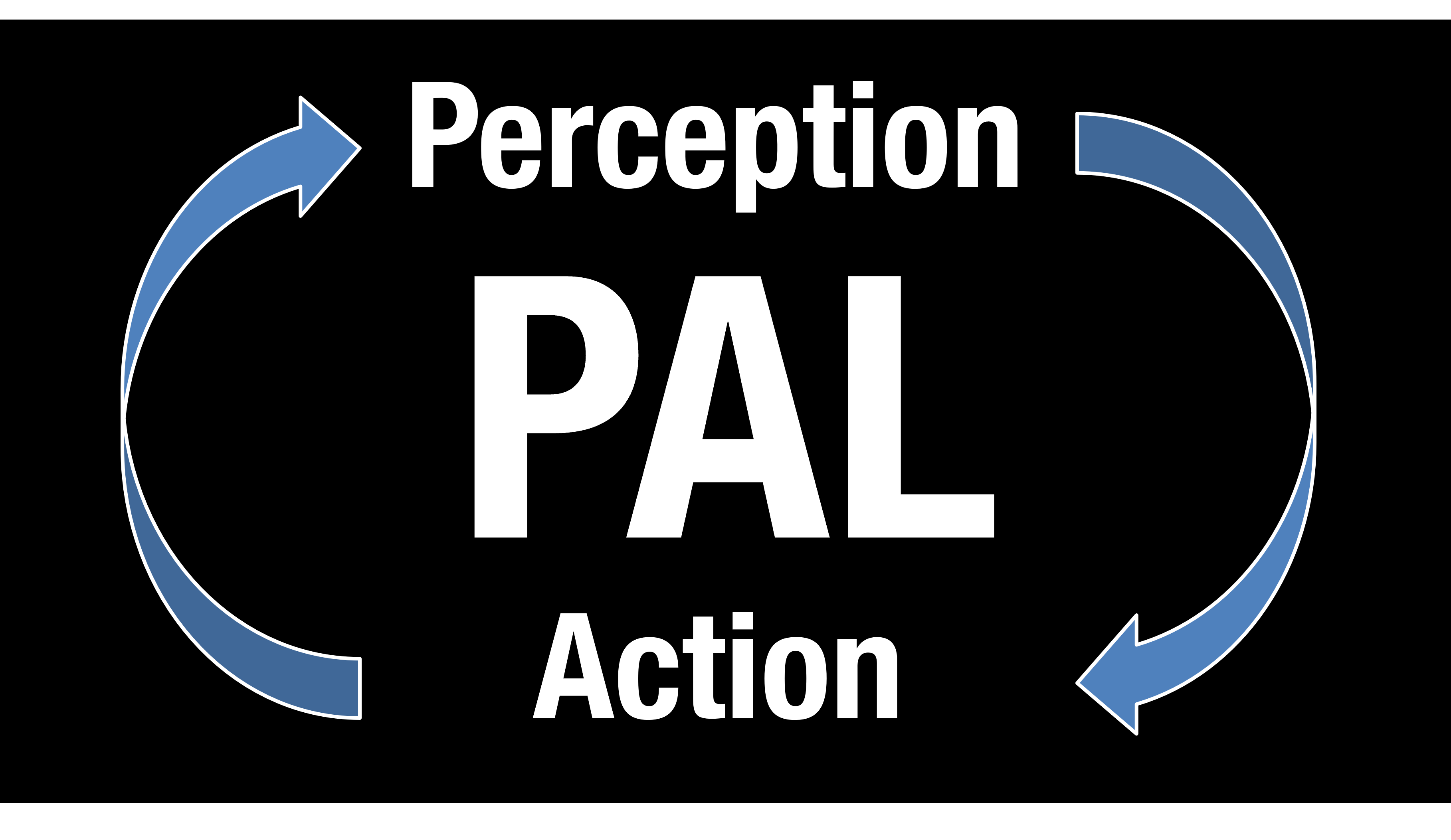
If we change the perceptual cues that drive an action, the action will change. This is one of the reasons why decontextualized practice doesn’t transfer well to the real world.
If we change the perceptual cues that drive an action, the action will change.
An Example
Let me give you a real world example. Lets look at typical firearms range training. Lets say we are teaching the trainee to draw and shoot in response to some sort of threat. We instruct the trainee to draw when we yell threat and fire two shots to the center mass of the target while remaining stationary . The traditional idea is that this activity, if repeated many times, will develop a motor program (e.g. muscle memory) that he trainee can then draw on in a real life situation.
Now lets treat this as a PAL. Perceptually what is happening? The trainee is standing still awaiting a verbal cue that will trigger him or her to draw and fire two shots at a completely stationary and non-reactive target. So the perception that triggers the initial action is a verbal cue and the trainee knows that cue is coming. So the PAL is something like verbal cue → activate two shot target engagement sequence → run post engagement sequence (breath, scan, ect.).
Now lets look at this situation on the street. The officer will be interacting with the suspect. The suspect will make a sudden move. He will produce a weapon. The officer must interpret that, decide that deadly force is required, draw, fire until the threat is stopped, and then do whatever is needed post shooting (I’m not going deep into this part for the sake of brevity).
So what does that look like as a PAL? Talk to suspect → See furtive move → Track suspect’s hand(s) → See if he has a weapon → Draw → Fire until suspect is stopped → Begin post engagement process. Of course all of this is happening at below the conscious level if you want to have any chance of doing it fast enough to save your life.
So we can see that the two PALs are very different. The state of the officer is different initially. The cues that trigger shooting are different, and the cues that trigger stopping the shooting are different. We are also assuming that neither the officer nor the suspect move during the encounter. Lots of video of real shootings shows that this is not a good assumption.
Yeah, But . . .
Then next objection usually goes something like, “Yeah, but they will still run the motor program that we practiced.”
No and Yes. First, this does not seem to always be the case. In this study, officers drew and shot faster when facing a changing assailant with a knife than when they were instructed to draw and fire as fast as they could in a practice session. In many cases they achieved greater speed by not using their well rehearsed motor programs, but by doing a different action. They did things like firing from the hip or shooting before the gun was pushed all the way out. In this study, participants used different drawing motions when they we attacked during a scenario than they demonstrated during practice.
In both of these studies, trainees are using different actions when placed in more realistic situations because the situations give different perceptual cues which produce different actions. In other words, the PALS are different.
In this study, many of the trainees did use something close to their default shooting action, but even then they added movement. In the study, officers were executing a traffic stop when the driver suddenly pulled a gun. Most of the participants back pedaled or sidestepped, drew their gun, and then fired from a traditional shooting posture. The problem here was that it took the officers about 1.5 seconds to do this when the suspect fired in about .5 seconds. Given the positioning of the officers, they might have been more successful if they had tried to grab or deflect the suspect’s gun and then drawn one-handed, but few officers attempted anything like this. Presumably this was because they had only or mostly practiced their standard drawing and firing process so that is what they did under pressure. In this situation then, the officers ran something close to the well rehearsed PAL (it was still different), but it was not an effective solution. This is because the generic perceptual cue of threat was tied to a generic action of draw and fire. We don’t want officers to have generic stimulus → generic response reactions. We want officers who are sensitive to relevant information and adapt their actions to this information (This, by the way, is a common definition of skill and is called attunement in EcoD).
The guys from A.U.FIRE were recently at our facility and gave me another example. For those who aren’t familiar, the A.U.FIRE system uses a conducting sleave attached to something like a tens unit to incapacitate a trainee’s arm. The electricity locks the arm in position so that the trainee cannot use it. The idea is to simulate a gunshot injury and then let the student work around the injury. A.U.FIRE’s founder (Tim Pearce) said that when he conducts training, it is amazing to see how people respond when their shooting arm/hand is immobilized. Students often will spend a substantial amount of time trying to force their dominant hand to work and sometimes have to be specifically told to use their non-dominant hand. This is a result of the generic stimulus → generic response model. This is a shooting situation → activate shooting program. Shooting program not working → ERROR! Just experiencing the situation a few times is enough for the trainee to develop a basic solution, but they have to experience it.
So What Are We Supposed to Do?
If you have been reading this Stack, you already know what I am going to say. We should be using the Constraints-Led Approach (CLA) to broaden the number of solutions that the trainee has explored. The CLA is about designing training that actually reflects the real problems people face. Instead of drilling isolated skills, CLA asks: What’s the task? What’s the environment? What’s the individual bringing to the table? Those three things—task, environment, and individual—are the constraints that shape how skills emerge. For example, in firearms training, the environment (inside vs. outside, low light vs. daylight) and the task (engaging a moving suspect, protecting a third party, or responding to an ambush) will interact with the individual’s experience, physical capabilities, and stress response. These factors shape how the shooter perceives the situation and what actions emerge as viable. The goal isn’t to teach people specifically what to do, but to help them figure it out in context. That way, when the pressure’s on, the skill shows up.
There are four key ideas that drive the Constraints-Led Approach. First is intention - training needs to be organized around a meaningful goal, not just going through the motions. Second, we constrain to afford - we design constraints that encourage certain possibilities for action (affordances) without prescribing one fixed response. This invites useful actions while still allowing for flexibility and individual adaptation. Third, we focus on representative design - the training should reflect the real decisions, timing, and information people will face in the field. And finally, we use repetition without repetition - we create many chances for problem-solving, each with slight variation, because that’s how people learn to adapt under dynamic, unpredictable conditions. For more on the CLA, check out this post.
We’re not preparing people for calm. We’re preparing them for chaos. That means reps without realism and drills without decisions just don’t cut it. If we want performance when it counts, we need to train in context, under pressure, and with purpose. That’s what CLA delivers. It’s not a nice-to-have - it’s the bare minimum if we’re serious about readiness.
Another great article. Sense-making, problem solving and adaptability have to be developed along with the skill sets and in context with the varying situations police face. So IMHO all that has to be interceded or blended in our learning and development. Why school solutions don’t always work is the mindset of tell them what to do verses teach them how to think and do.
Great stuff you’re doing here. Keep up the great work! 👍
I like the concept. It mirrors OODA Loop taught in the Marine Corps. which stands for Observe, Orient, Decide, Act its a decision-making model developed by Colonel John Boyd, a U.S. Air Force fighter pilot. its effectiveness in fast-paced, high-stakes environments like combat. I also think that when people focus to much on fundamental repetitiveness, it opens the door for complacency. Dr. Eric Burguirere, a neuroscientist, explains that through the practice of an action, there is a shift from using the prefrontal cortex initially to the striatum as the action is repeated. This repetition gradually modifies certain circuits in the brain, which then take over and automate the process (Burguirere, 2023). This the part where people say you have developed a skill through repetition. The biproduct of habit is a double edge sword in this field. Habits are a valuable feature of the brain. However, they can also make people less aware of their surroundings and lead to complacency (Burguirere, 2023). PAL enables action to the unexpected. good stuff. Thanks for sharing Dr Blair