
Shooting the Wrong Person
The impact of inhibitory control

Publication
Biggs, A. T., & Pettijohn, K. A. (2022). The role of inhibitory control in shoot/don’t-shoot decisions. Quarterly Journal of Experimental Psychology, 75(3), 536–549. https://doi.org/10.1177/17470218211041923
What Was the Issue?
Shooting the wrong person is one of the worst outcomes in any armed encounter. Whether it’s a military operator mistaking a civilian for a threat or a law enforcement officer firing on an unarmed subject, unintended casualties represent a catastrophic failure — not just of tactics, but of cognitive control.
We know that reaction time and marksmanship matter. But researchers Biggs and Pettijohn asked a more granular question: does inhibitory control — the cognitive ability to stop a prepotent response — predict who shoots people they shouldn’t? And does it also predict whether you can effectively engage the threats you do need to shoot?
How Did They Look at It?
The study used 62 active-duty Navy personnel as participants. Researchers administered a battery of five cognitive tasks designed to measure different facets of inhibitory control:
Classic Go/No-Go — respond to targets, withhold response to non-targets
Hybrid Go/No-Go — a novel task combining go/no-go and stop-signal elements with varying stimulus proportions (mostly-go, mostly-stop, ambiguous)
Stop-Signal Reaction Time (SSRT) — measures how quickly you can cancel a response already in motion
Color Continuum Task — uses color stimuli with a spectrum from clear go to clear stop signals, with ambiguous stimuli in between
Face Stimuli Task — same structure as the color task, but uses emotional face photographs as stimuli (introducing potential emotional biases)
After the cognitive battery, participants completed a video-based shooting simulation — realistic military scenarios where they had to engage actual threats (lethal hits) while avoiding shooting non-combatants (false alarms / unintended casualties).
The researchers first ran a principal component analysis (PCA) on all the task metrics to identify the underlying cognitive dimensions. They then used hierarchical regression to test which components predicted shooting performance, controlling for marksmanship skill and total rounds fired.
What Did They Find?
The PCA revealed five distinct cognitive factors from the inhibitory control battery:
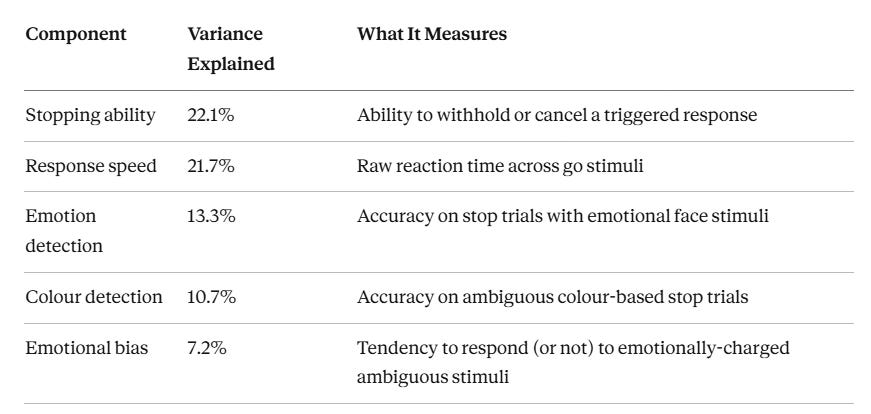
Those five components were then tested against the two shooting outcomes. The results were clean and specific:
Stopping ability predicted false alarms (unintended casualties): β = −.295, p = .01. Participants with better inhibitory control. Those who could more effectively cancel a triggered response shot fewer people they shouldn’t have. This relationship held even after controlling for marksmanship.
Response speed predicted lethal hits: β = −.236, p = .02. Faster responders landed more lethal shots on actual threats.
Notably, neither of the emotion-related components (emotion detection or emotional bias) significantly predicted either outcome. The effects were specific to the more fundamental cognitive abilities: stopping and speed.
So What?
Biggs and Pettijohn argue that inhibitory control plays a prominent role in shoot/don’t-shoot decisions, and crucially, that this influence holds even when you account for basic shooting performance variables like marksmanship and total rounds fired. Stopping ability is the primary factor linked to shooting errors; response speed best describes effective engagement of actual threats. These are distinct mechanisms, and the authors frame them using a go signal / stop signal architecture: optimal inhibitory control means both high stopping ability (to avoid unintended casualties) and fast reaction time (to respond swiftly against hostile adversaries).
On the null result for emotional factors: the authors note that emotional bias components might better predict shooting errors if scenarios were designed to more readily evoke individual biases. They cite racial prejudice research as an example. As a general influence in this study, emotional bias was a non-significant predictor compared to the more dominant role of inhibitory control failures.
The authors are explicit that the findings point toward the potential value of cognitive training for military and law enforcement personnel, though they stop short of claiming training effects — the study establishes the cognitive-performance link, not whether that link can be deliberately developed. Several future directions are flagged: whether anxiety and force-on-force conditions would elevate the importance of inhibitory control further; how priming and rules of engagement interact with individual differences; and how different scenario types might emphasize different components of inhibitory control.
On limitations, the authors acknowledge that lethal force encounters involve too many variables to capture in a single study or simulation. The current scenarios also did not include the anxiety-provoking elements of real force-on-force encounters, which prior research suggests can bias individuals toward shooting — meaning the role of inhibitory control under high-threat conditions remains an open question.
My $.02
What I find compelling here is that it appears that shooting speed and the ability to stop a response appear to be genuinely separate mechanisms - not two ends of the same dial. That has real implications for how we think about selection and training, because you can’t assume that getting faster makes someone more likely to shoot the wrong person, or that working on restraint slows them down.
The question the paper leaves open is the one that actually matters for practitioners: can we train stopping ability? The correlational design tells us it predicts unintended casualties, but not whether it’s teachable. That’s the next study someone needs to run — and until it exists, this research gives us a good reason to ask the question seriously rather than assume marksmanship and tactics cover everything.
Interesting article, thank you.
Very interesting. It would be interesting equally to read non-agenda driven articles on the influence of racial bias, on this subject.
Like does a woman coming at you hysterically wearing a hijab automatically mean she’s a terrorist and therefore is fired upon or a woman in a Che Guevara tshirt or a White Pride tshirt?
No hidden agenda in my question. Interested in the subject and IF a positive correlation, how do we as military, LEO or trained civilians work to mitigate for that?
Hope the question makes sense.🤷🏼♂️