
Takedown or Knockout: Same Law, Different Reactions
One punch against one punch is legally textbook. The audience doesn't score it that way.

Publication
Eleuterio-da-Rocha, J., Tanksley, P. T., Martaindale, M. H., Johncox, J., & Blair, J. P. (2026). Striking or grappling? Comparing public and officers’ perceptions of police use of force. Journal of Criminal Justice, 103, 102601. https://doi.org/10.1016/j.jcrimjus.2026.102601
What Was the Issue?
Cops use hands-on control far more often than they use firearms. One large department study put firearm discharges at 0.8% of use-of-force incidents and arrest-and-control techniques at 66%. The research on public perception of use of force has concentrated on firearms, weapons, and body-worn-camera framing. Nobody had directly asked whether the specific kind of unarmed force matters. Is a punch rated the same as a takedown when the legal picture is identical?
How Did We Look at It?
Video vignettes, randomized 2 × 2 × 2 × 2 factorial design. The scenario was the same across all 16 conditions: an officer enters a room where a male suspect is actively assaulting a smaller female victim. The suspect swings at the officer. The officer either (1) slips the punch and throws a single counter-punch, knocking the suspect down, or (2) slips the punch and executes a double-leg takedown. In both versions, the suspect immediately complies and is controlled and handcuffed. Officer and suspect race were varied (Black or White), and each video existed in a full version and a segmented three-clip version.
Two samples rated officer performance on a 4-point scale (blameworthy to excellent): 996 civilians recruited via a Qualtrics panel matched to the U.S. adult population, and 744 law enforcement officers drawn from a random 20,000-officer subset of the ALERRT Center trainee database. Analysis used OLS regression with robust standard errors, checked against ordered logistic models.
What Did They Find?
Both groups rated grappling higher than striking, and officers were tougher judges of the strike than civilians were.
Civilians: grappling rated 0.20 points higher on the 4-point scale than striking (95% CI [0.11, 0.30], p < 0.001, Cohen’s d = 0.26). The share rating officer performance “excellent” was 48.2% for grappling versus 34.1% for striking.
Officers: grappling rated 0.27 points higher (95% CI [0.18, 0.36], p < 0.001, Cohen’s d = 0.43). The “excellent” share was 66.5% for grappling versus 42.9% for striking, a 24-point spread that was wider than the civilian gap.
Officer race did not affect ratings. Suspect race did not affect ratings after adjusting for multiple comparisons. The two race hypotheses (H3, H4) both confirmed null. Neither suspect race nor officer race were shown to impact judgments.
Video format had no overall effect, but officers rated grappling “excellent” 78.2% of the time when it was shown in segments versus 55.9% when shown as an uninterrupted clip. Civilians did not shift the same way.
Punishment was off the table for almost everyone. Across both samples and both conditions, most respondents said the officer needed no sanction. The only punishment option that cleared double digits in the civilian sample was “additional training” (above 15%, higher for the striking condition). In the LE sample, every punitive endorsement landed under 1%.
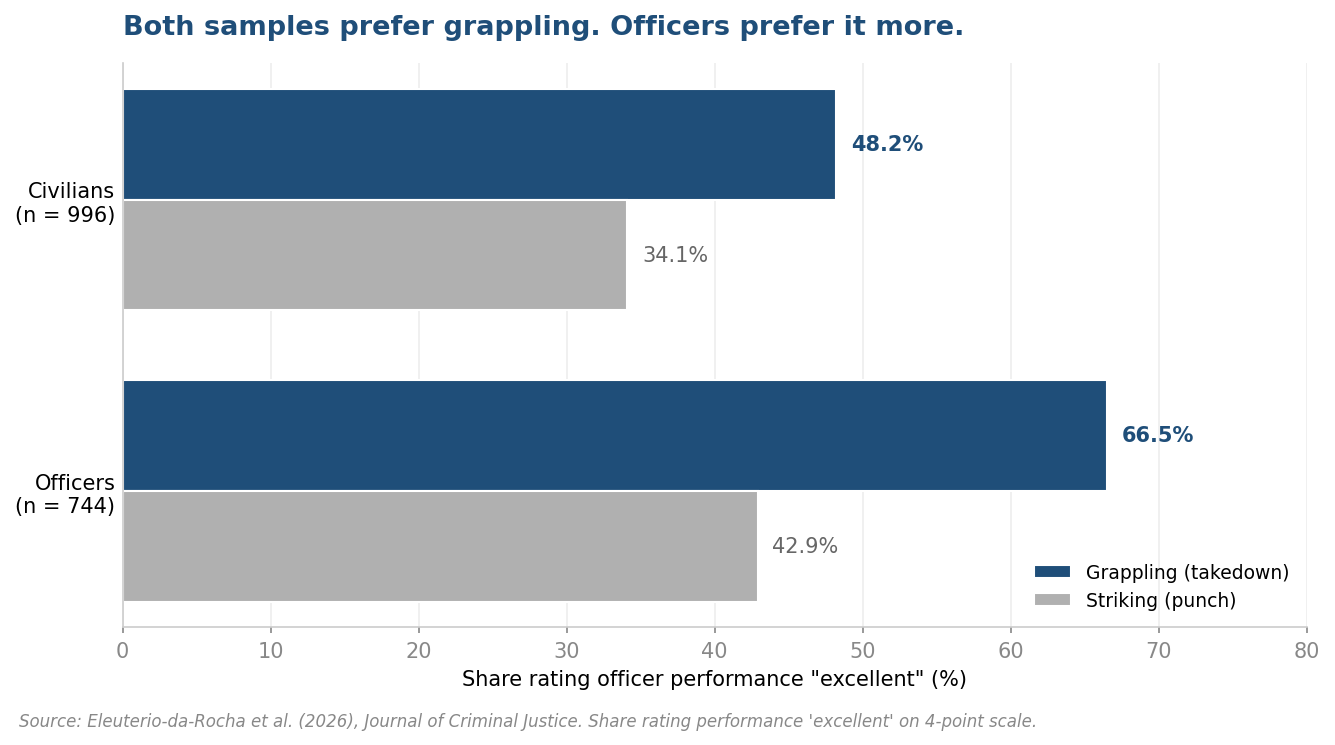
The striking condition was technically textbook: one punch in reply to one punch, same level of force, same timing, lawful and proportional by standard use-of-force reasoning. It still rated lower than the takedown.
So What?
We frame the paper as a perception study, not a prescription for training or policy. Our specific implications were:
Grappling carries a perceptual premium that striking does not, even when both are equally lawful and equally proportional. The gap is larger among officers than civilians, which we read as officers being more fluent in the form-versus-function distinction.
Training should prioritize grappling where context allows. This is not a rigid rule. Striking remains appropriate and lawful when the situation calls for it. The right answer depends on situational demands and officer capability.
Public communication about use-of-force incidents should foreground the technical proportionality of the response rather than the visual result, and review processes should focus on resistance-response alignment rather than how bad the outcome looks on screen.
Breaking video footage into reviewable segments makes officer evaluators more charitable, but it does not change civilian evaluators. That asymmetry has implications for how agencies structure BWC review.
The findings do not support categorical policy restrictions on striking. Public support for any punishment was low in both conditions, so policymakers should not infer a mandate from these data.
My $.02
We ran this as a “no-duh” study. Everyone I’ve talked to says grappling just looks better than striking, but nobody had tested it. So we did, and found what we expected.
To me, grappling should be the foundation of police defensive tactics. I’m not saying you shouldn’t teach some striking. I’m saying grappling should be the primary method of gaining control. Grappling can produce control without injury. Striking relies on injuring a person to make them quit or incapacitate them. Now we have evidence the public reads the difference too.
My career in LE started in the early 70's. Back then it wasn't uncommon to see LE slugging it out, or pistol whipping a suspect. To much TV, not enough training, liability wasn't an issue as they said the Perp deserved it. I didn't go that route, I don't recall ever having hitting a suspect during an arrest, etc. Being a high school and college wrestler, they never knew what hit them as they were being cuffed. Defensive tactics through proper training is a very vital tool, pistol whipping someone is going to put you on the street faster than the Perp because of unemployment and civil suits. Having a 100 pound GS police dog along really is an influencer. LE may have gotten away with this years ago, but with so many camera's on the officers and in the area, be as professional and justified in the use of force . Stay Safe out there!
For some meat for a further study: the takedown versus the "body slam." Especially with larger officers versus smaller "slam-ees," women and obvious juveniles included. Though arguably the body slams will be less legally defensible.