
The Anxiety Bias
Why officers shoot more under pressure

Publication
Nieuwenhuys, A., Savelsbergh, G. J. P., & Oudejans, R. R. D. (2012). Shoot or don’t shoot? Why police officers are more inclined to shoot when they are anxious. Emotion, 12(4), 827–833. https://doi.org/10.1037/a0025699
What Was the Issue?
Anxiety degrades performance. That’s not a controversial claim. But how it degrades shoot/don’t-shoot performance is less well understood. Does anxiety slow you down? Make you less accurate? Or does it do something more specific, something that changes the direction of your errors rather than just their frequency?
This study asked a pointed question: when officers are anxious, are they more likely to shoot people they shouldn’t? And if so, is the problem that anxiety changes what they’re looking at, or how they’re interpreting what they see?
How Did They Look at It?
Thirty-six experienced police officers (33 men, 3 women; mean age 37.79 years; mean service 14.92 years) completed a video-based shoot/don’t-shoot test under two conditions: low anxiety (LA) and high anxiety (HA). All held a full license to carry a firearm on duty.
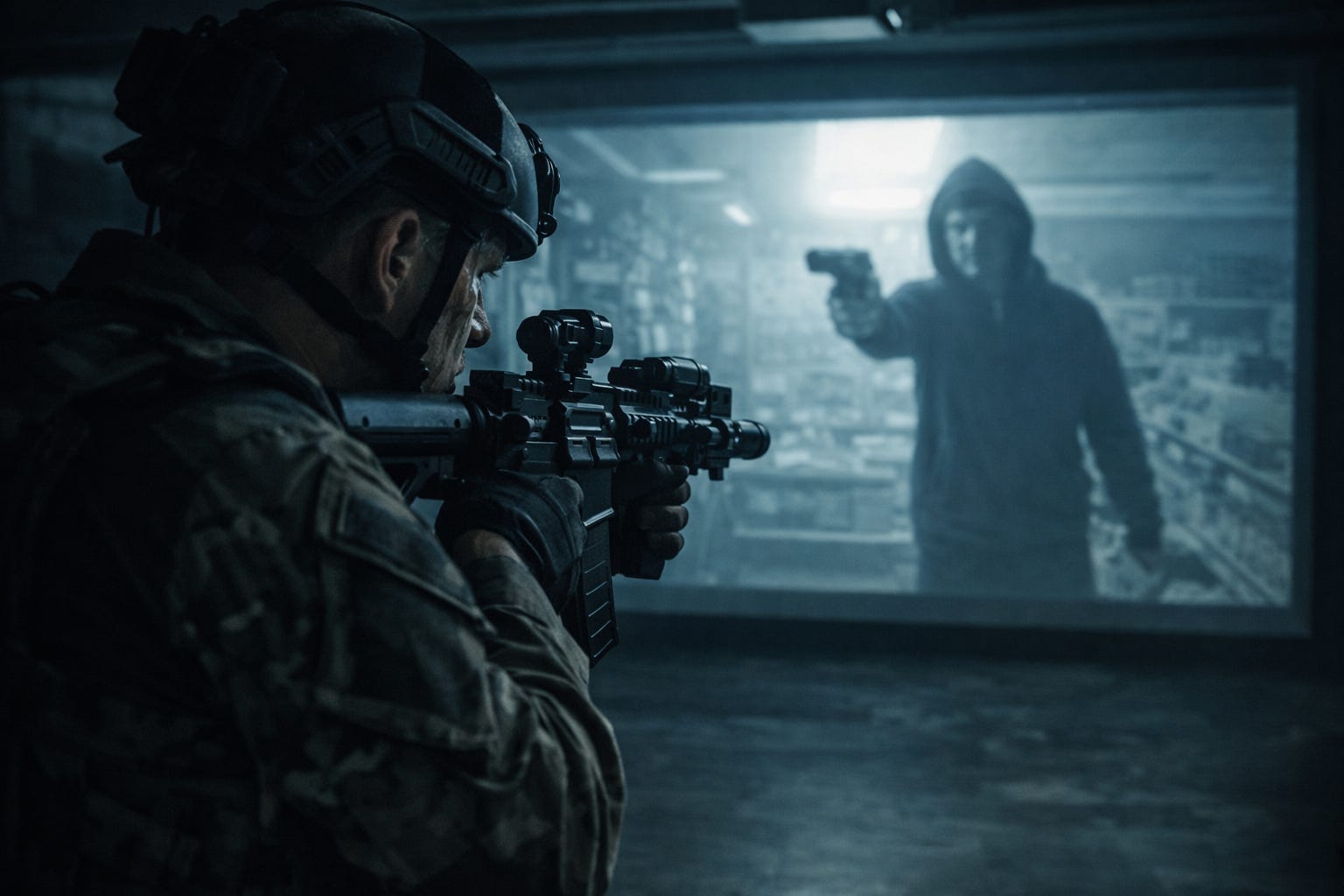
Scenarios were projected life-size on a 6.0 × 2.5m screen. Officers stood 5m away and used a blank-firing Walther P5 fitted with a laser diode. Each officer ran 48 trials per condition in counterbalanced order. Two trial types: GUN (suspect draws and fires; correct response: shoot) and NO-GUN (suspect shows empty hands and surrenders; correct response: hold fire).
The anxiety manipulation was physical. In the HA condition, a “shoot-back cannon” (an air-pressure system firing 15mm plastic projectiles) was pointed at officers’ legs and activated on GUN trials. Each officer was hit 5–7 times during the session. In the LA condition, the cannon was present but switched off, and officers were told it would not fire. Subjective anxiety, mental effort, and heart rate were recorded to confirm the manipulation worked.
Twenty of the 36 officers also wore a mobile eye tracker, allowing the researchers to measure gaze behavior throughout, specifically where officers were looking before suspects appeared (scan ratio), when they first fixed on the suspect (fixation onset), and how long they held that fixation (fixation duration).
What Did They Find?
The manipulation worked. A MANOVA confirmed significant differences between conditions (λ = .410, F(3, 33) = 15.84, p < .001, η² = .590). Officers reported higher anxiety (F(1, 35) = 35.24, p < .001, η² = .502), higher mental effort (F(1, 35) = 13.19, p < .001, η² = .274), and higher heart rate (F(1, 35) = 5.69, p = .023, η² = .140) in the HA condition.
Shooting decisions:
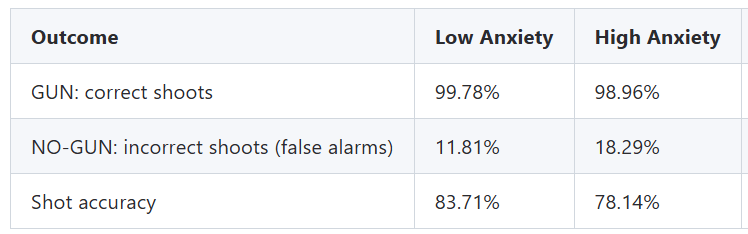
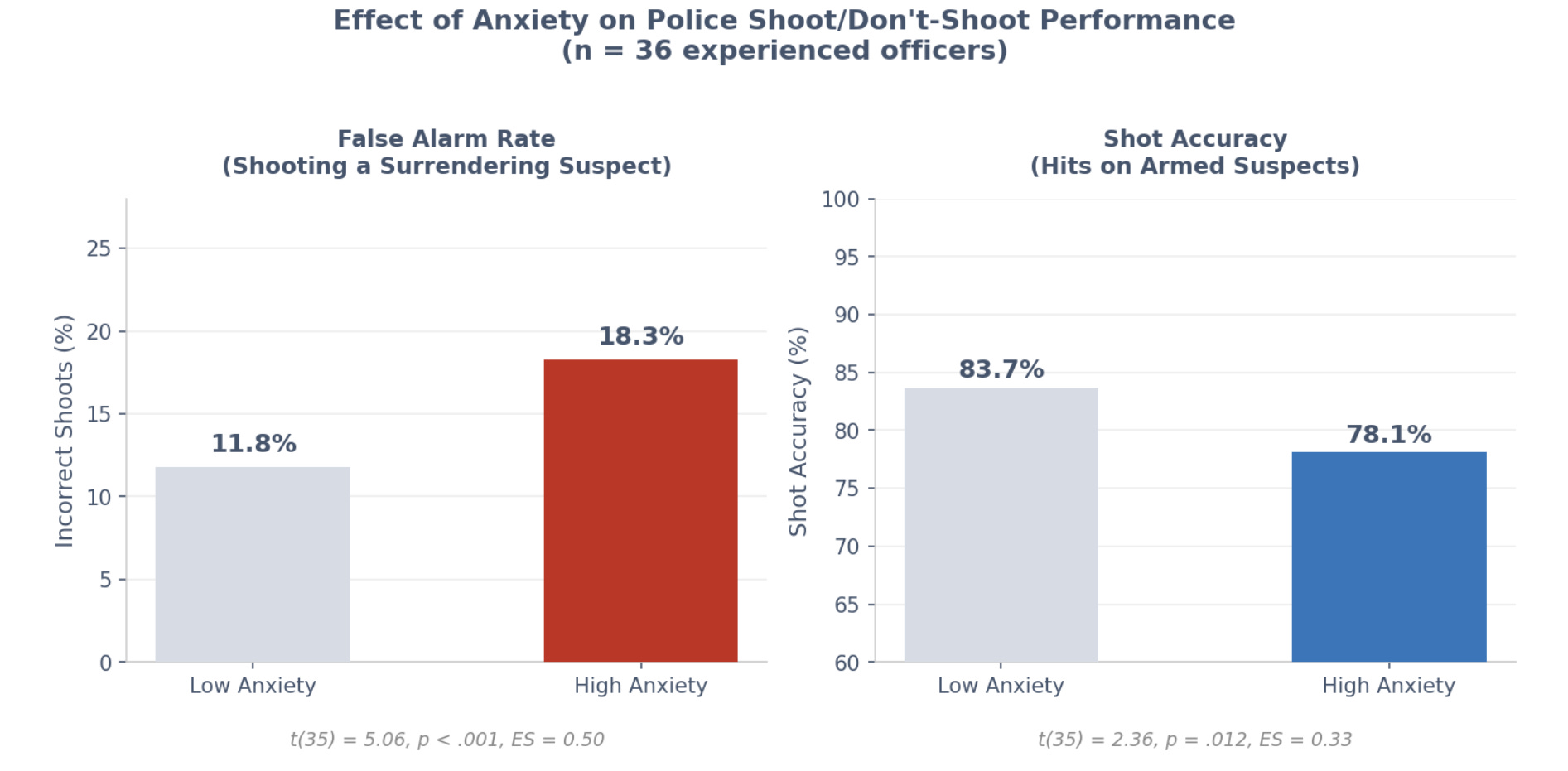
Under anxiety, officers shot surrendering suspects significantly more often; the false alarm rate increased by roughly 55% relative to baseline (from ~12% to ~18%). In the HA condition, approximately one in five surrendering suspects was shot.
Response times:
Officers responded faster on GUN trials under anxiety: 493ms (LA) vs. 467ms (HA), t(35) = 3.94, p < .001, ES = 0.52 (a ~6% reduction). No significant difference in response times for correct NO-GUN trials. Notably, incorrect NO-GUN responses (shooting a surrendering suspect) were about 100ms faster than correct GUN responses in both conditions, suggesting they were not triggered by visual confirmation of a weapon.
Gaze behavior:
No significant differences between LA and HA for scan ratio (p = .147), fixation onset (p = .306), or fixation duration on NO-GUN trials (correct or incorrect). The only significant gaze difference was a shorter fixation duration on GUN correct trials under HA (394ms vs. 372ms, p = .047), consistent with the faster response times in that condition.
So What?
The authors argue that the pattern of results points to a response bias toward shooting under anxiety, rather than a global performance failure. Officers’ ability to engage actual threats was largely preserved; accuracy dropped slightly and responses were faster, but they were still shooting the right people. The problem was false positives: surrendering suspects being shot at dramatically higher rates.
Because gaze behavior was essentially unaffected by anxiety, the authors conclude the failure is not attentional. Officers were looking at the same things. The breakdown is interpretational: under anxiety, they were responding on the basis of threat-related inferences and expectations rather than the actual visual information in front of them. The finding that incorrect NO-GUN responses were ~100ms faster than correct GUN responses supports this; officers weren’t waiting to see a gun before firing, they were firing before that information could be processed. Officers’ own self-reports supported this interpretation: many noted that the first sight of a suspect was often sufficient to trigger a shooting response when the cannon was active.
The authors frame this within Attentional Control Theory (Eysenck et al., 2007), which holds that anxiety weakens the prefrontal inhibitory control that governs goal-directed behavior, while simultaneously increasing amygdala activation and heightening sensitivity to threat-relevant cues. The result is a stronger expectation of threat and a lowered threshold for emotion-congruent (shoot) responses, without any corresponding change in where the eyes are pointed.
The authors note that prior work (Nieuwenhuys & Oudejans, 2011) showed officers under threat shift gaze toward the head and weapon of an opponent. The fact that gaze was not meaningfully altered here may reflect the specific nature of this task, as suspects appeared suddenly from behind objects, limiting time available for strategic gaze allocation, rather than indicating gaze is generally robust to anxiety.
On limitations, the authors acknowledge that the shoot-back cannon produces only modest anxiety compared to actual armed encounters, and that the simulation environment, however realistic, differs from live encounters in ways that may affect generalization. They also note participants had significantly lower trait anxiety than population norms (t(28) = 5.22, p < .001), which may limit how far the findings extend to officers higher in trait anxiety.
The authors suggest future research should examine whether reality-based training, meaning training that specifically incorporates anxiety-inducing elements similar to actual encounters, can offset the bias toward shooting under pressure.
My $.02
This study joins a growing list of research showing that changing the environment changes behavior. That shouldn’t be surprising, but the implication for training often gets ignored.
We know officers are going to work in high-anxiety environments. That’s not a possibility; it’s a certainty. So the question isn’t whether anxiety affects performance (it clearly does), it’s whether we’re preparing people for it. And the honest answer for most agencies is no. Most training happens in environments that are physically safe, socially comfortable, and psychologically low-stakes. Officers get very good at performing under those conditions. Then they go to work somewhere else entirely.
The fix isn’t to overwhelm people in training. It’s to deliberately introduce anxiety and progressively increase it as trainees can handle it, building the skill of performing under pressure the same way you’d build any other skill. We don’t teach someone to swim by throwing them in the deep end, but we also don’t teach them by keeping them in the shallow end forever. If anxiety is going to be present in the real environment, it needs to be present in the training environment too.
Excellent points by the author. This type of research will save lives both in the moment and, because responders are better prepared and have better mental health, throughout their careers. Some incredibly salient points I pulled out to think about/discuss later:
- "failure is not attentional. Officers were looking at the same things. The breakdown is interpretational: under anxiety, they were responding on the basis of threat-related inferences and expectations rather than the actual visual information in front of them."
- "So the question isn’t whether anxiety affects performance (it clearly does), it’s whether we’re preparing people for it."
- "The fix isn’t to overwhelm people in training. It’s to deliberately introduce anxiety and progressively increase it as trainees can handle it, building the skill of performing under pressure the same way you’d build any other skill. We don’t teach someone to swim by throwing them in the deep end, but we also don’t teach them by keeping them in the shallow end forever."
Dr. Blair, thank you for posting.