
This guest post is written by Peter Tanksley, a research scientist at the ALERRT Center and lead author of the mortality study it draws on. To find out more about the work I do at ALERRT, check out the Research Ring website.
When Pete Blair covered our mortality study here a few weeks back, it struck a nerve. Circulatory disease, cancer, suicide, and COVID top the list of what kills officers, each at rates above the general public. But a list of causes isn’t a plan. This piece pulls three findings from the same data that speak directly to your wellness program.
Officer deaths concentrate after age 45. Over the following decade, the leading cause shifts from suicide and accidents to heart disease and cancer.
Officers’ clearest added risk compared to the public is suicide. Overdose plays a smaller role in officer deaths than it does for the public.
Male and female officers face different risks on the same job. The biggest gap against female officers isn’t suicide. It’s cancer.
1. Officer deaths concentrate after 45, and the causes change over the decade that follows
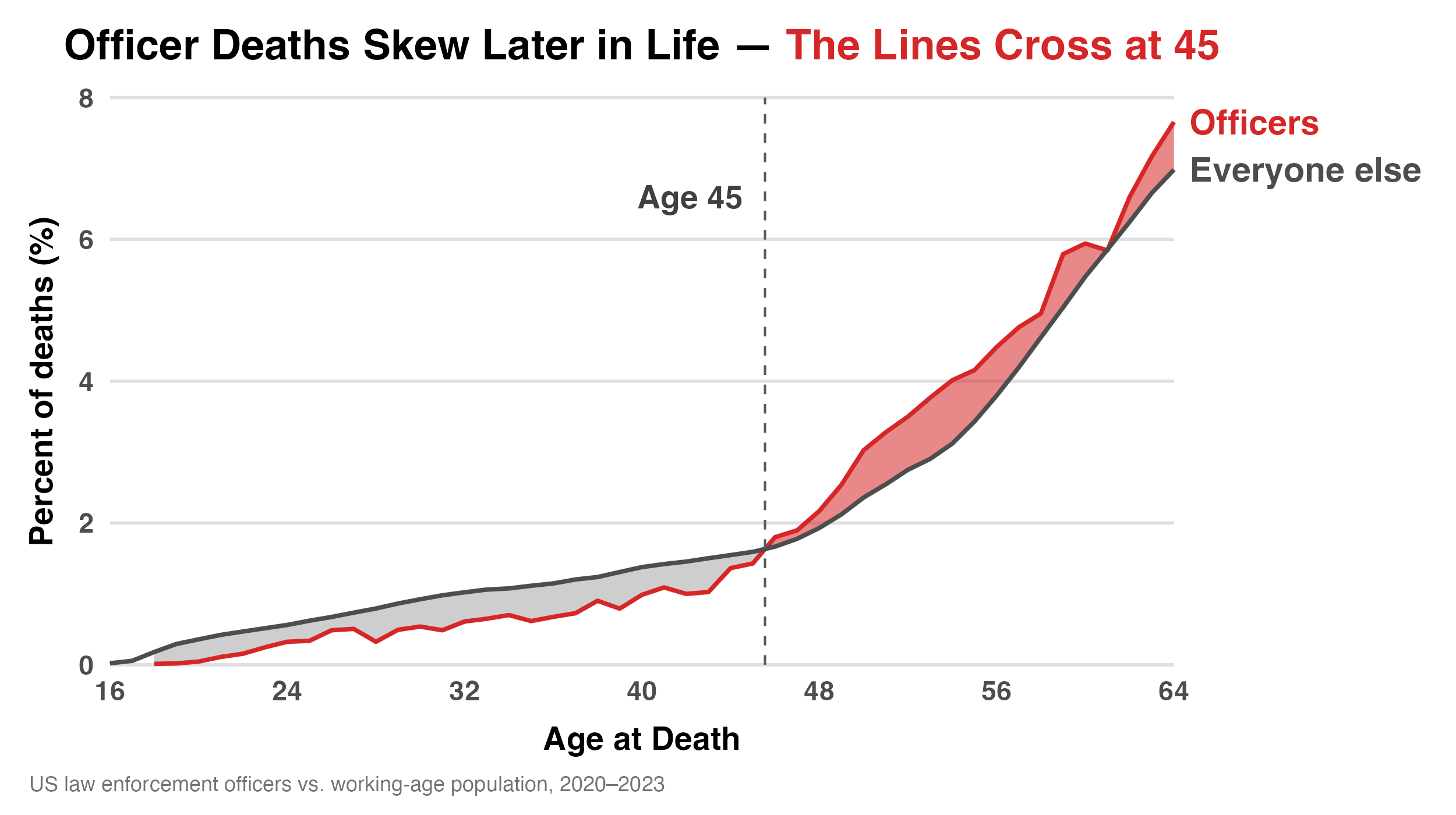
Officers die at higher rates than the general public. But for a wellness program, the more useful question is when. Officer deaths skew later in life than deaths in the general public. Before age 45, officers account for a smaller share of their deaths than the public does. After 45, a larger share. The chart below shows the age-45 crossover.
The cause of death shifts around the same time. Through their 40s, most officers who die still die from suicide, accidents, and other injuries. By their 50s, heart disease has taken over as the leading killer, and cancer isn’t far behind.
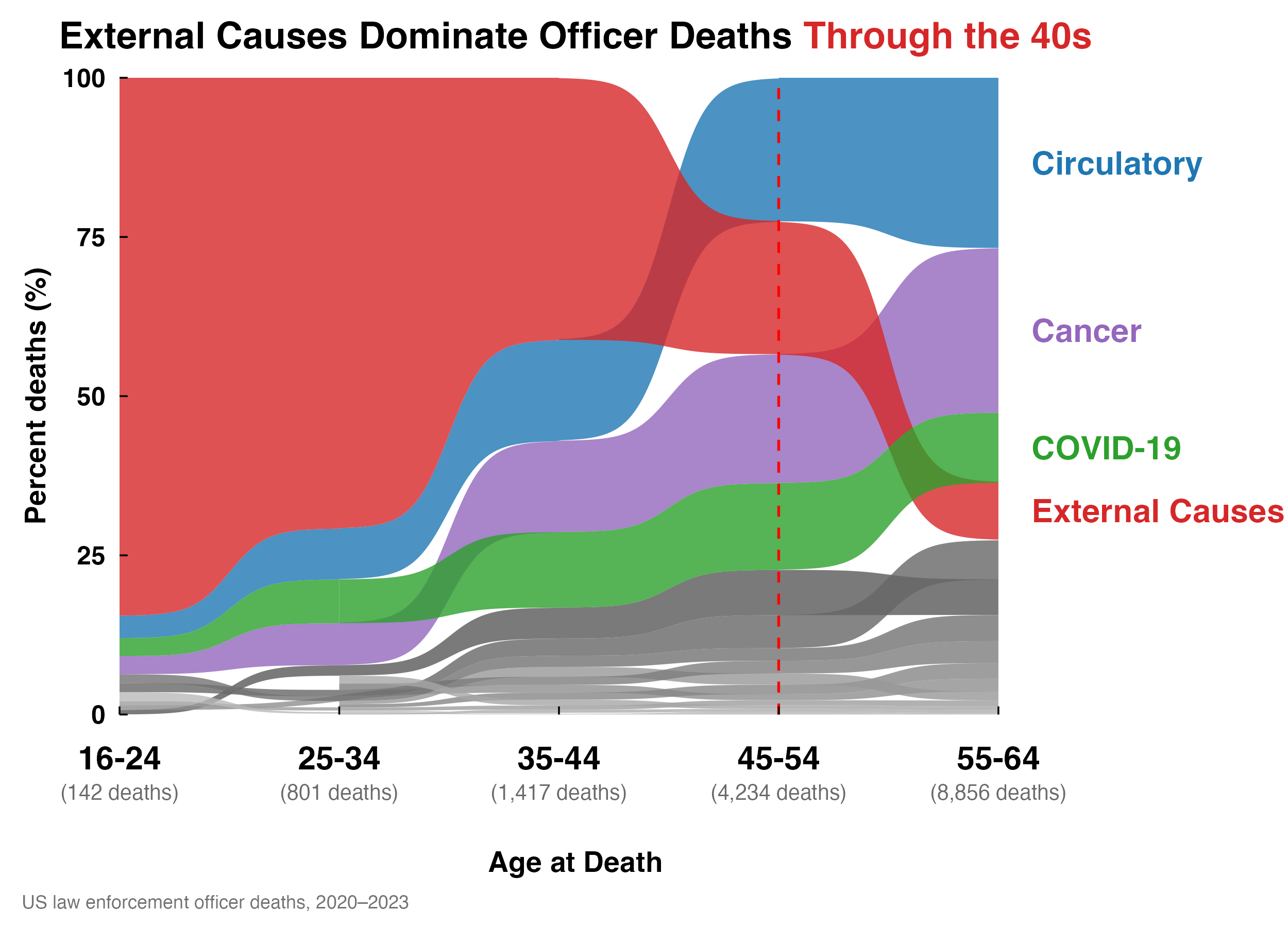
The deaths show up late, but the diseases behind them start early. Heart disease and cancer take decades to build before they kill anyone. If heart disease is the top killer by an officer’s 50s, the build-up started in their 20s and 30s.
What this means for your agency: most wellness programs front-load fitness at the academy. Then they stop paying attention right when the risk shifts to chronic disease. The early-career risk is real, but it calls for mental-health and crisis-intervention work, not a fitness test (more on that below). Heart and cancer screening should start in that same early-career window, not a decade or two later when the mortality numbers catch up.
2. Suicide is where officers stand apart
Suicide is elevated for officers overall. It happens by firearm far more often: 86% of male officer suicides and 73% of female officer suicides involve a firearm, against 55% and 36% in the general population. Officers are also less drug-involved than the public. Overdose and poisoning cause 82% of accidental deaths in the general population, against 48% for male officers and 59% for female officers.
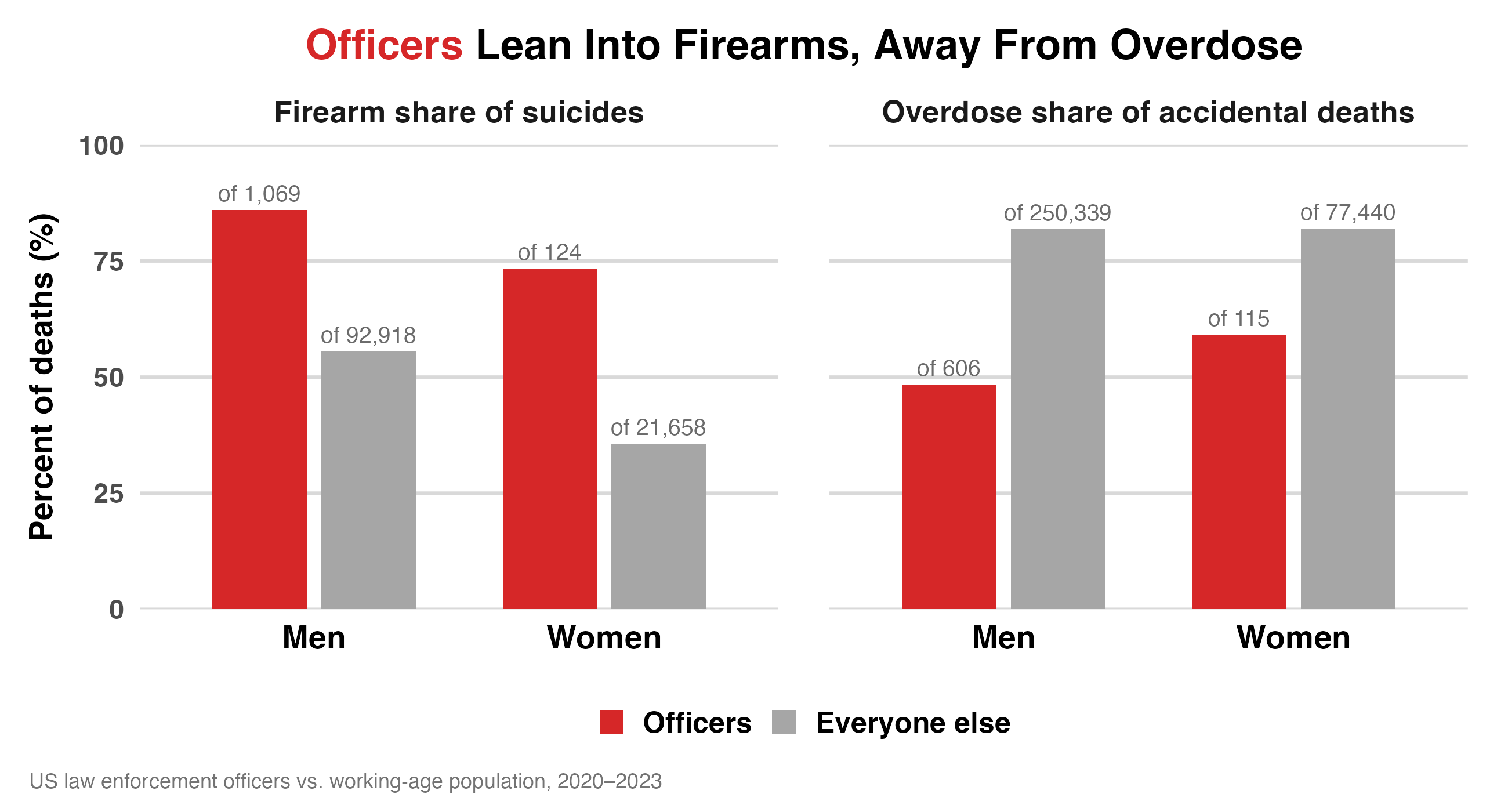
What this means for your agency: suicide is where officers show the clearest added risk compared to the public. When the crisis comes, a firearm is usually already at hand, so waiting for the crisis is waiting too long. The work starts years earlier, with the goal of keeping officers out of crisis in the first place: mental-health care officers use routinely rather than as a last resort, trained peer support that notices trouble early, and an Employee Assistance Program they actually trust and use. A poster in the break room doesn’t count.
3. Male officers vs. female officers
Who in your own agency is at greater risk? Compare male officers to female officers on the same job, not either group to the public.
The chart below shows, for each cause of death, how much higher one sex’s officer death rate is than the other’s. Suicide shows the biggest gap. Male officers die by suicide at a 68% higher rate than female officers, and circulatory deaths run 46% higher for male officers too. The gap runs the other way on cancer: female officers die of cancer at a 64% higher rate than male officers.
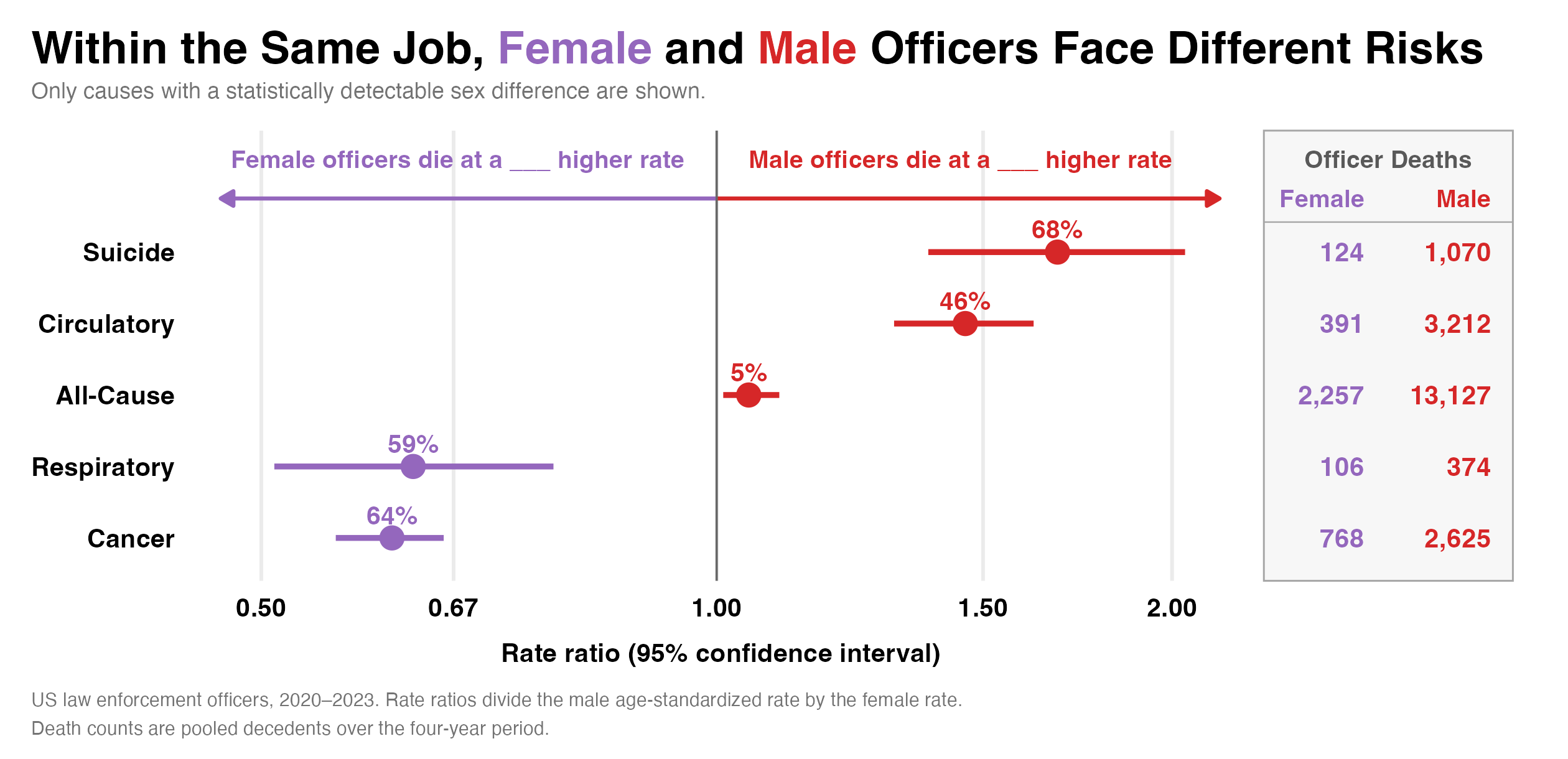
Respiratory disease points the same direction, at 59%, but that number is carrying far less weight than it appears to. A rate ratio tells you which way a gap runs, not how many officers are in it. Cancer killed 768 female officers over the four years we studied. Respiratory disease killed 106, few enough that it sits just above the cutoff below which we don’t report a rate at all. Cancer is the finding here. Respiratory disease is a signal worth watching.
What this means for your agency: a wellness program built around a "default officer" is probably built around a male officer. That means it’s probably missing cancer. Cancer is the leading cause of death among female officers, killing nearly twice as many as heart disease and stroke combined. It kills them at almost three times the rate of women in the general public, the widest gap of any cause we measured. And it’s the one place on the chart above where female officers clearly carry more risk than the men they work beside. If you add a single thing to your screening protocol for female officers, add cancer screening. This finding surfaced after the study was published, in a conversation with another researcher. It held up when we checked it.
Bonus finding: COVID-19 was the single leading cause of officer death in 2021, then fell to 11th by 2023. The ranked list of leading causes barely moves from year to year, which is what makes that spike remarkable.
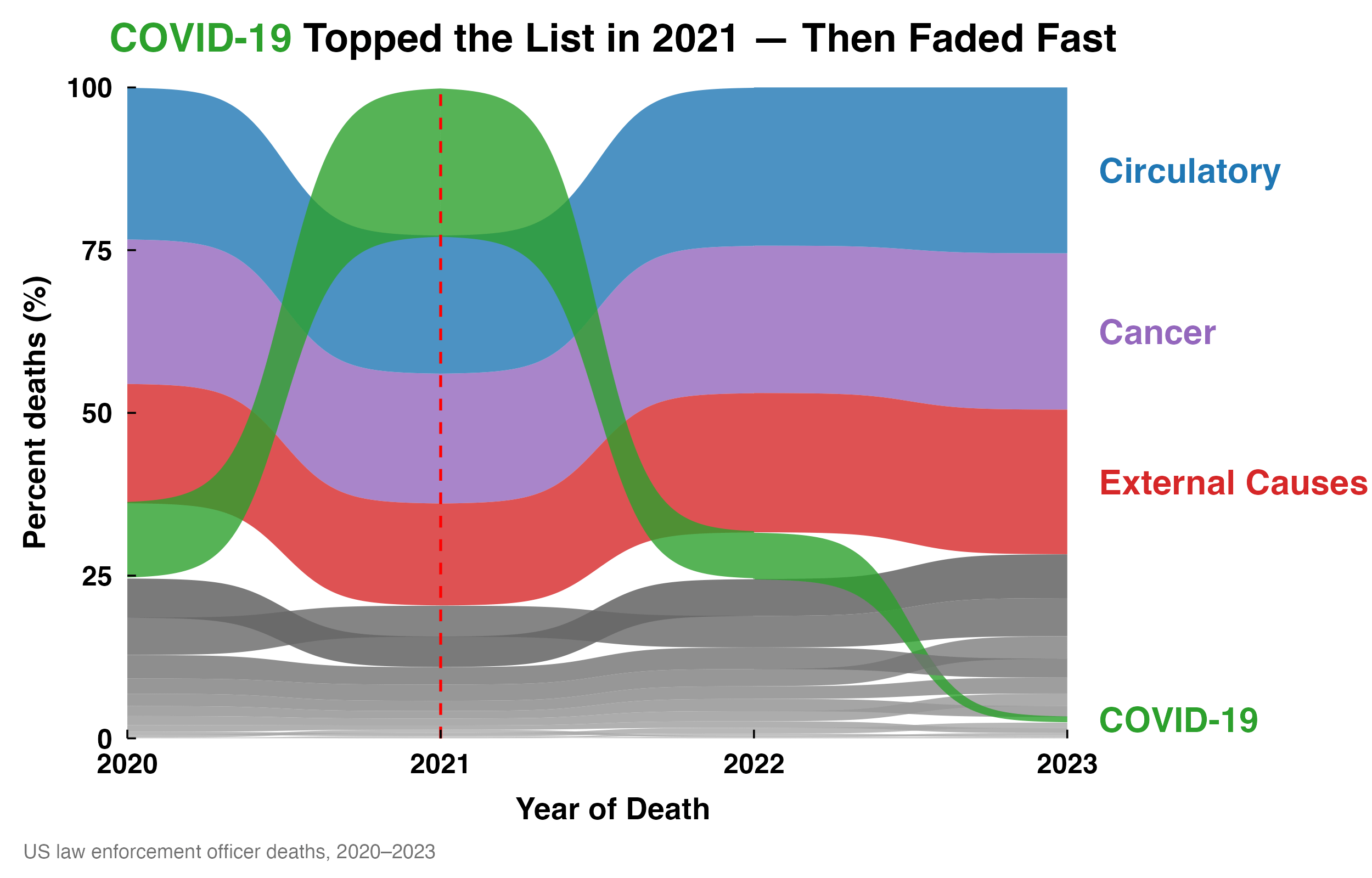
The lesson is that officers sit at the leading edge of public health crises. When a new health threat hits the public, officers meet it early. Heart disease, cancer, and suicide are today’s known risks. A wellness program built only around them will miss the next one. Staying current on mortality surveillance research, and staying agile enough to respond when a new health shock arrives, has to be part of the plan.
The original paper has the full methodology, including confidence intervals. This piece is the practitioner cut.
Read the full study: Tanksley, P.T., Barnes, J.C., Blair, J.P., & Martaindale, M.H. (2025). Mortality among law enforcement officers in the United States: a population-wide analysis of the National Occupational Mortality Surveillance data, 2020–2023. The Lancet Regional Health – Americas, 52, 101270. (open access)
A lot of the COVID deaths for officers like everyone else were probably people who died with COVID not of COVID. There were financial and other incentives for COVID reports. Officers do have to get up close and personal with sick people but those are more likely to be hepatitis infected.