
Training Changed. Force Dropped. No Added Risk to Officers.

Publication
Sanders, M., Bancroft, K., Hume, S., Chetwynd, O., & Quinton, P. (2025). The impact of training on use of force by police in an English police force: Evidence from a pragmatic stepped wedge randomized controlled trial. Justice Evaluation Journal, 8(1), 20–39. https://doi.org/10.1080/24751979.2024.2412333
What was the question?
The authors asked whether a redesigned national training curriculum could reduce police use of force in real-world policing. Specifically, they examined whether the new Public and Personal Safety Training (PPST) curriculum developed by the College of Policing reduced officers’ likelihood of using force, altered the types of force used, and affected injury rates for officers and members of the public. A central concern was whether reductions in force could be achieved without increasing risk to officers or producing unintended consequences such as depolicing.
How did they look at it?
The study used a large-scale pragmatic stepped-wedge randomized controlled trial in a single English police force, Avon & Somerset. A total of 1,843 frontline officers participated over a 12-month rollout. Officers were assigned to receive the training based on when their mandatory refresher training was due, which functioned as quasi-random assignment. All officers eventually received the intervention, allowing the authors to compare officer behavior before and after training using officer-level fixed effects.
The primary outcome was whether an officer used force in a given week, based on nationally standardized use-of-force reporting data that officers are required to complete whenever force is used. Secondary outcomes included the number and type of force used, the demographics of people subjected to force, and whether officers or members of the public were injured. The final dataset consisted of nearly 185,000 officer-week observations, providing substantial statistical power and allowing the authors to examine both overall effects and specific categories of force.
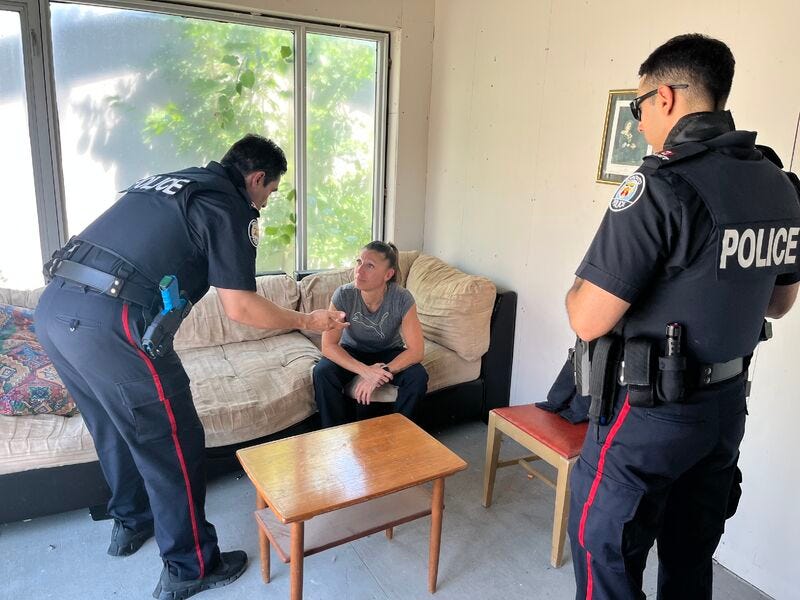
The training itself represented a significant departure from traditional personal safety training. Rather than emphasizing repetitive drills designed to automate specific physical techniques, the PPST curriculum centered on scenario-based role play drawn from common police–public conflict situations. During the pilot, five scenarios were used: custody, domestic incidents, street fights, stop and search, and interactions with vulnerable persons. Each scenario was designed to expose officers to varying levels of resistance, ranging from compliance to aggravated resistance, with those levels changing across repetitions.
Officers trained in small, mixed-experience groups and rotated through roles as the officer, the member of the public, and an observer. Trainers did not begin by re-teaching techniques. Officers were expected to rely on skills they already possessed and adapt to the unfolding situation. Trainers could pause or rewind scenarios to highlight key moments, and short breakout teaching sessions were used only when common difficulties emerged across the group. The stated goal of the training was to improve officers’ ability to manage conflict, assess threat, and apply force only when lawful, necessary, and proportionate.
What did they find?
The authors found statistically significant reductions in police use of force following the training. Officers who had received PPST were between 8% and 11% less likely to use force in a given week compared to the counterfactual. On average, this amounted to approximately 0.7 fewer uses of force per officer per year, which translates into over thirteen hundred fewer uses of force annually across the force.
The largest reductions were observed in physical force, which is both the most common category of force and one associated with higher injury risk. There were no statistically significant increases in the use of weapons or other more severe force options. Importantly, the reduction in force did not coincide with an increase in officer injuries. At the same time, injuries to members of the public declined by roughly one-third.
The authors also examined whether reductions in force differed across demographic groups. While the study was underpowered to draw strong conclusions about subgroup effects, the patterns suggested broadly similar reductions across gender categories and promising, though statistically inconclusive, reductions in force directed at Black and other minority ethnic groups. There was no evidence of contamination across treatment waves and no indication of depolicing, as measures such as arrests and calls for service remained stable.
So what?
The authors argue that these findings provide strong evidence that training can meaningfully reduce police use of force in operational settings. The consistency of the effects across multiple models, combined with the stepped-wedge design and use of real-world administrative data, supports their conclusion that the observed reductions are attributable to the PPST curriculum rather than broader trends or external influences. They emphasize that this addresses a significant gap in the literature, particularly in the UK context, where rigorous evaluations of use-of-force training have been limited.
They also highlight that the reductions in force were not accompanied by compensatory harms. The training was associated with a substantial reduction in injuries to members of the public and no statistically significant increase in officer injuries. The authors interpret this as evidence that officers were not simply avoiding force at the expense of their own safety, nor disengaging from core policing activities. Aggregate data on arrests, searches, and calls for service did not suggest depolicing.
Finally, the authors emphasize the methodological contribution of the study. They argue that pragmatic stepped-wedge trials offer a feasible and robust approach for evaluating police training when traditional randomized controlled trials are impractical due to operational constraints. From their perspective, the study demonstrates that police organizations and researchers can collaborate to generate high-quality evidence that is both scientifically credible and operationally relevant.
My $.02
This was a massive study with very promising results from a relatively modest intervention. Twelve hours of training over two days produced small changes at the individual officer level, but meaningful reductions in use of force when scaled across the organization. Just as important, reduced force was accompanied by fewer injuries to members of the public and no increase in officer injuries. There was also no evidence that officers disengaged from proactive policing, suggesting the effect was not driven by fear of scrutiny or depolicing.
The training approach relied on scenario-based training, where officers work through realistic calls for service from start to finish. Rather than isolating skills or techniques, training is embedded within realistic policing contexts. Instructors can pause scenarios to address decision points or briefly target specific problems, then restart the scenario. The authors’ findings suggest that this kind of training design can change real-world behavior without increasing risk, which is a claim many training programs make but few studies actually demonstrate. Professor Chris Cushion explains more here.
What is worth noting is that while many elements of this training closely resemble what would be described as Ecological Dynamics or Constraints-Led training, Professor Cushion arrived at this approach through a different theoretical route. His work draws primarily on traditional information-processing frameworks, and he has been openly critical of EcoD. While the characterization of ecological approaches can be criticized, engaging in a theoretical debate over mechanisms is not especially useful here.
What matters is the convergence. Both lines of work arrive at the same core insight: learning that transfers must be situated in representative contexts. When training reflects the structure and demands of real policing, behavior changes in the field. This study adds strong empirical support to that claim, regardless of the theoretical language used to explain it.
In my next post, I will introduce the 4 Ps of knowing and explain how they help clarify many persistent training problems while sidestepping unproductive arguments about learning mechanisms.
Great. Just did a podcast with the authors of the study!