
Training Taught Them the Wrong Thing
The assumptions buried in how we teach officers might be doing more damage than the stress of the job.

Publication
Blair, J. P. (2026). Beyond the transfer gap: an ecological dynamics framework for police training design. Evidence Base. https://doi.org/10.1080/30679125.2026.2662641
What Was the Issue?
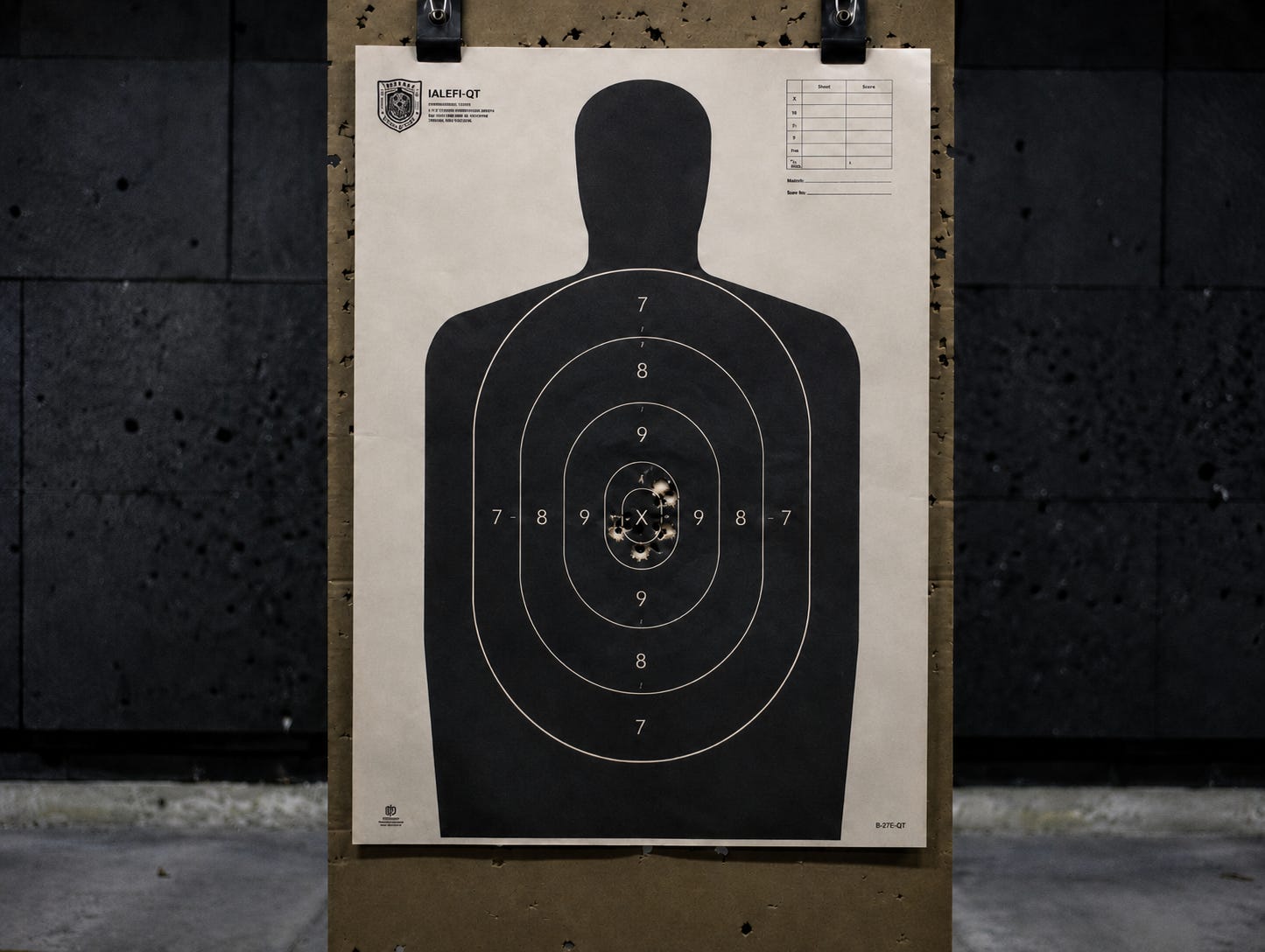
Police firearms training produces qualification accuracy rates above 90%. Officer-involved shooting data tell a different story: per bullet accuracy is about 25% in the field. The incident-level hit rate (did any bullet fired by any officer hit any suspect) is higher, but nowhere near 90%. Some of this gap is irreducible. No training reproduces the stakes of a real gunfight, but a 65%+ accuracy swing is too large to wave off. That is not a modest training-to-performance difference. It is a structural transfer failure, and it happens with the skill that gets more hours than any other in American policing. If transfer fails where we invest the most, what should we expect from de-escalation, crisis communication, complex decision-making, and defensive tactics, which get a fraction of the time that firearms training gets?
I argue the gap is not just a resources problem. It is also a design problem. Current training is built on assumptions about how people learn, and those assumptions predict exactly the failures we see. This paper makes those assumptions visible and offers a coherent alternative.
How Did I Look at It?
This is a framework paper, not an experiment. The approach was to identify the assumptions that shape current training design, show why they produce predictable transfer failures, and lay out an alternative grounded in a mature research tradition. I draw on police training research from the U.S., U.K., Germany, and Australia, and on two decades of ecological-dynamics work in sport science and applied perceptual-motor learning. Three streams come together in the paper: Ecological dynamics (affordances, perception-action coupling), the constraints-led approach that Davids and colleagues developed in sport, and Vervaeke’s four kinds of knowing, which I add to push the framework beyond perceptual-motor skills into professional judgment.
What Did I Find?
The transfer gap is real and structural. It is not just a motivation problem or a resource problem. Sloan et al. (2025) found that about 70% of academy time already goes to operations and weapons skills, and yet we still see the huge transfer gap that I discussed above.
Current training rests on three inherited assumptions. Each one predicts exactly this failure.
Skill is a stored program. Master a technique, retrieve it under pressure. This is Fitts and Posner’s stage model. The problem is that field encounters never match the conditions under which the program the specific program was encoded. The combinations of distance, lighting, terrain, subject behavior, and officer state are endless, and there is simply not time in training to build separate motor programs for each combination.
Complex skills are built from simple parts. Decompose, drill each part, reassemble. The problem is that decomposition strips out the informational relationships between the parts that make the integrated skill work. An officer who can shoot accurately on a range and recite use-of-force law has two isolated competencies, not integrated use of force judgment.
Perception, decision, and action happen in sequence. This is the OODA loop, at least as practice has absorbed it. The problem is that in a real encounter there is no pause between perceiving and acting. They are continuous and reciprocal. Additionally, many of the perceptual cues used in training do not resemble the cues that trigger or control actions in the field. Timer beeps and static targets teach officers to respond to cues that are very different from the perceptual information that actually drives field performance.
Ecological dynamics offers a coherent alternative. Skill is not a stored program you activate. It is your ability to achieve goals under varying conditions. Perception and action are one continuous process. Behavior self-organizes from the interaction of individual, task, and environmental constraints, shaped by the performer’s intention. There is no single “correct” technique. Many different actions can achieve the same functional goal.
The constraints-led approach turns this into design through four principles. Intention: give the learner a functional goal, not a prescribed technique. Constrain to afford: manipulate task and environmental constraints to make some solutions more or less available without dictating one. Representative design: training tasks must contain the perceptual information that drives performance in the real setting. Repetition without repetition: the goal repeats; the solution varies.
Vervaeke’s four kinds of knowing sit on top of this. These are: propositional knowing (facts and rules), procedural knowing (skills), perspectival knowing (reading the room), and participatory knowing (being in the role). Most of what makes a competent officer is not propositional. Yet, much of training focuses on the propositional. It’s not that facts aren’t important, but Vervaeke argues that all learning is grounded first in the participatory and the propositions develop downstream from that. The “forget what you learned in the academy” phenomenon, documented for over 50 years, is what happens when propositional knowledge acquired in isolation fails to integrate into professional competence in the field.
Taking together, Ecological Dynamics, the Constraints Led Approach, and Vervaeke’s ways of knowing suggest that training should start with immersing students in representative situations rather than starting with facts, moving to isolated procedures, and then (maybe) adding scenarios at the end.
The policing evidence supporting the new approach is limited but consistent. Koerner et al. (2021) compared constraints-led and traditional knife-defense instruction with recruits. The constraints-led group defended successfully against 81.8% of attacks versus 55.6% for the traditional group. On a surprise attack neither group had trained against, the constraints-led group held at 81% while the traditional group dropped to 19%. Olma et al. (2024) showed scenario-based firearms training transferred to realistic scenarios where marksmanship-focused training did not, while the scenario based training developed comparable marksmanship. Sanders et al. (2025) ran a stepped-wedge Randomized Controlled Trial of scenario-based conflict management training in an English force and found reduced use of force and fewer civilian injuries. All of this lines up with a much larger body of work in sport science.
So What?
The implications are about design.
Start with participatory engagement and let propositional knowledge find its place inside that experience. Put recruits in representative situations from the earliest stages, calibrated to what they can handle, and add complexity as they are ready. The progression runs from simple-representative to complex-representative, not from decontextualized drill to sudden scenario immersion.
Representative does not mean maximally complex. It means preserving the perception-action relationships that drive real performance. A first-week recruit handling a domestic-violence scene where one party has already left is a legitimate representative task. It is just the simplest functional version of the situation. As the student progresses more complex scenarios can be introduced.
The decision landscape of policing is dominated by choices to communicate, de-escalate, reposition, wait, or withdraw. Using force is important, but happens downstream of these activities. A training environment that presents only targets to engage has deleted the most frequent and most consequential decision an officer makes: whether to use force at all. Ecological-dynamics design puts use of force decisions at the core of training.
The trainer’s role changes too. It moves from demonstrator and corrector to designer of learning environments. The coach moves from showing “the right way” to handle something to creating situations that allow the student to experience what the trainer already knows.
My $.02
I wrote this paper to get my current thinking on training into the peer-reviewed literature. It and the companion book chapter (https://www.crimrxiv.com/pub/lx805j63/release/1) lay out where I am now.
If you run a training program and want somewhere to start today, start here: take one skill you currently teach as a scripted technique and instead put it in a scenario where the technique is sometimes required to achieve the student’s goal.