
Two Variables Explain the Suicide School Shooter


Publication
Sanders, K., Chermak, S.M., Freilich, J.D., & Klein, B.R. (2025). School shootings and suicide: A comparison of school shooters who die by suicide and non-suicide school shooters. Crime & Delinquency, 71(10), 3362-3390. https://doi.org/10.1177/00111287241268387
What Was the Issue?
School shooters are not a monolithic group. Some kill or wound others and are captured, surrender, or walk away. Others kill others and die by suicide – either during or immediately after the attack. This distinction matters for prevention: if suicidal attackers have a meaningfully different profile, that profile might be detectable before an attack occurs.
How Did They Look at It?
Researchers used the Trauma and Justice Strategic Research Initiative for School Shootings (TASSS) database – one of the most comprehensive open-source databases available – to identify 253 juvenile school shooters from 1990 to 2016. They compared 40 who died by suicide or made suicidal attempts, threats, or plans to 213 who did not. Logistic regression examined psychological issues, race, family problems, peer aggression, school failure, leakage of intent, age, gang membership, and total deaths caused.
What Did They Find?
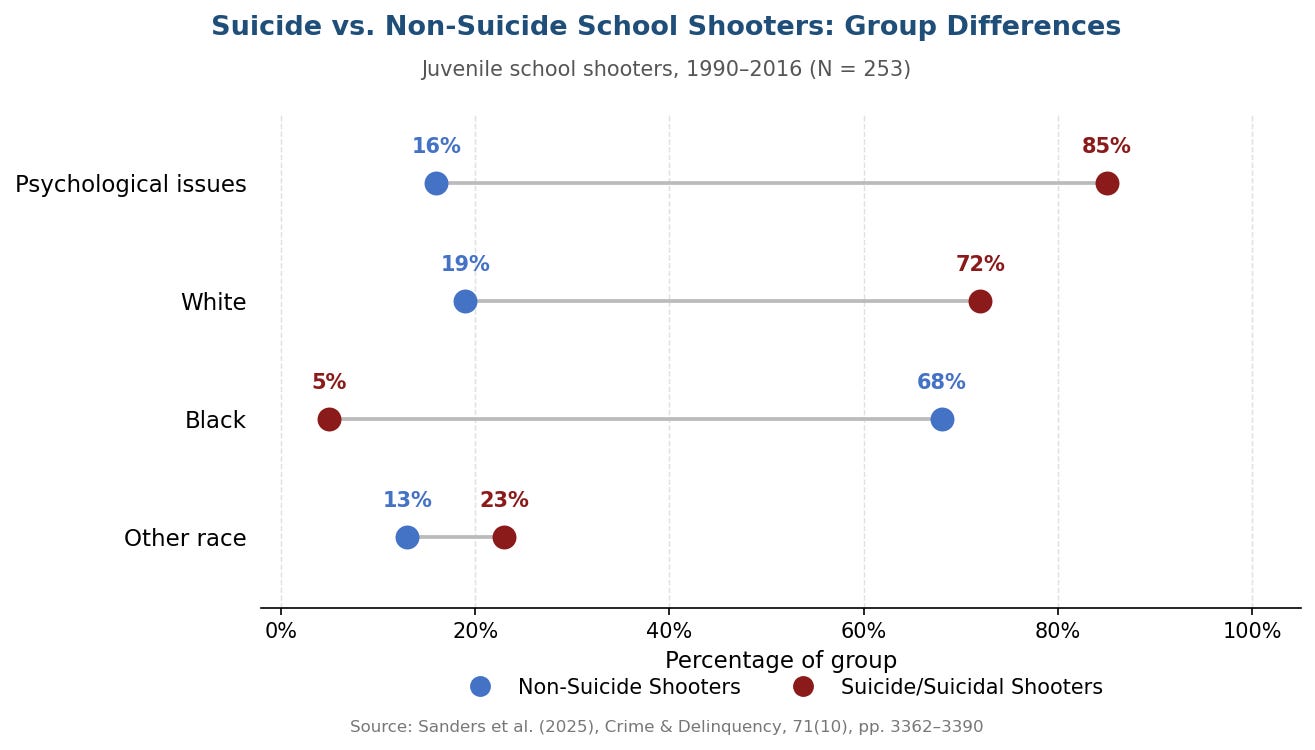
Descriptively, the gaps between the two groups were large. Among the 40 suicide shooters, 85% had documented psychological issues versus 16% of the 213 non-suicide shooters. White shooters made up 71.8% of the suicide group versus 19.3% of the non-suicide group; Black shooters accounted for 68% of non-suicide shooters but only 5.1% of suicide shooters.
In the multivariate model, only two variables reached statistical significance. Shooters with documented psychological problems were 17 times more likely to be in the suicide group. White shooters were 5 times more likely to die by suicide than non-White shooters. Family problems, school failure, and leakage were all elevated among suicide shooters descriptively, but none held up in the multivariate models – the small suicide subgroup size (n = 40) limited statistical power.
So What?
The mental health signal is the loudest variable in the dataset, and it aligns with the broader suicide literature. The racial pattern mirrors general population trends: suicide rates are lower among Black Americans, with cultural factors including perception of suicide as “a White thing” and stronger social and religious buffers cited as protective mechanisms.
Because school shootings are often planned and suicide is premeditated, there is typically a window for intervention. The authors argue school staff should prioritize students who combine psychological issues with family instability, poor school engagement, and leaked intentions.
My $.02
The 17x greater risk for psychological issues is striking, but “psychological issues” is a catch-all variable here – it ranges from depression to conduct disorder. That’s useful for broad risk screening but not specific enough to guide clinical intervention. The variable tells you mental health matters enormously; it doesn’t tell you which mental health problems to act on first.
Sample size is a limitation: n = 40 for the suicide group limits what you can reliably model. Because TASSS captures virtually all reported incidents in the study period, this isn’t a sampling failure – it’s a function of how rare these events are. The authors are honest about that, but it means we should be cautious about how far we push interpretations.
For threat assessment professionals: the combination of documented mental health history, family dysfunction, school failure, and leakage represents the highest-risk profile in this dataset.
Thanks for posting this. The most effective treatment we can give is prevention, with disease, with active attacks, with fires, and with relationship problems. It is important that we become proactive rather than reactive, and your posts and writing continually preach that. Thanks, Dr. Blair. Keep going.