

Publication
Morrison, G. B., & Vila, B. J. (1998). Police handgun qualification: practical measure or aimless activity? Policing: An International Journal of Police Strategies & Management, 21(3), 510-533. https://doi.org/10.1108/13639519810228804
What Was the Issue?
Every state mandates that police officers qualify with their handgun, first as recruits and then periodically through their careers. The whole apparatus rests on a quiet assumption: that an officer who shoots above the cutoff on a qualification course is competent to use a handgun in an armed confrontation. Morrison and Vila asked whether that assumption holds. Do the doctrines, courses, and threshold scores American departments use to certify shooters bear any tested relationship to what officers actually do in a gunfight?
How Did They Look at It?
The paper is a critical historical and descriptive review, not a new dataset. The authors do three things. First, they trace the development of American police handgun training from the mid-nineteenth century forward, with particular attention to the two institutions that shaped it most: the National Rifle Association between the World Wars and the FBI after World War II. Second, they describe how qualification standards (course content, distances, target types, time limits, threshold scores) actually got set. Third, they compare field shooting performance across three groups using statistics drawn from prior published studies and departmental reports: untrained nineteenth-century police officers (Roussey’s 1984 New Orleans data, 1863-1889), contemporary opponents of police presumed to have no formal training (departmental reports from New York City, New York City Transit, Philadelphia, Chicago, and Houston), and contemporary trained, qualified police officers (multiple departments from the mid-1970s through the early 1990s, including Chicago, NYC, Los Angeles, Metro-Dade, St. Louis, Baltimore, Dallas, and others). The performance indicators are incident hit rate, person hit rate, fatality rate, and bullet hit rate.
What Did They Find?
The history is the setup; the comparison is the payoff. On the history side, contemporary qualification courses are direct descendants of two non-validated sources: pre-1945 NRA bull’s-eye matches and the FBI’s Practical Pistol Course, which dates to the early 1940s. Neither was designed from field-shooting data. Performance thresholds were inherited from the military and from competitive shooting (the FBI started its PPC threshold at 60% and bumped it to 85% by 1943, both arbitrary). As of 1970, departments still disagreed on course content, length, frequency, and threshold scores, and many sent officers who failed back on patrol with no remediation. New York City in the late 1960s allowed officers to miss the target completely with 12 of 50 shots and still qualify.
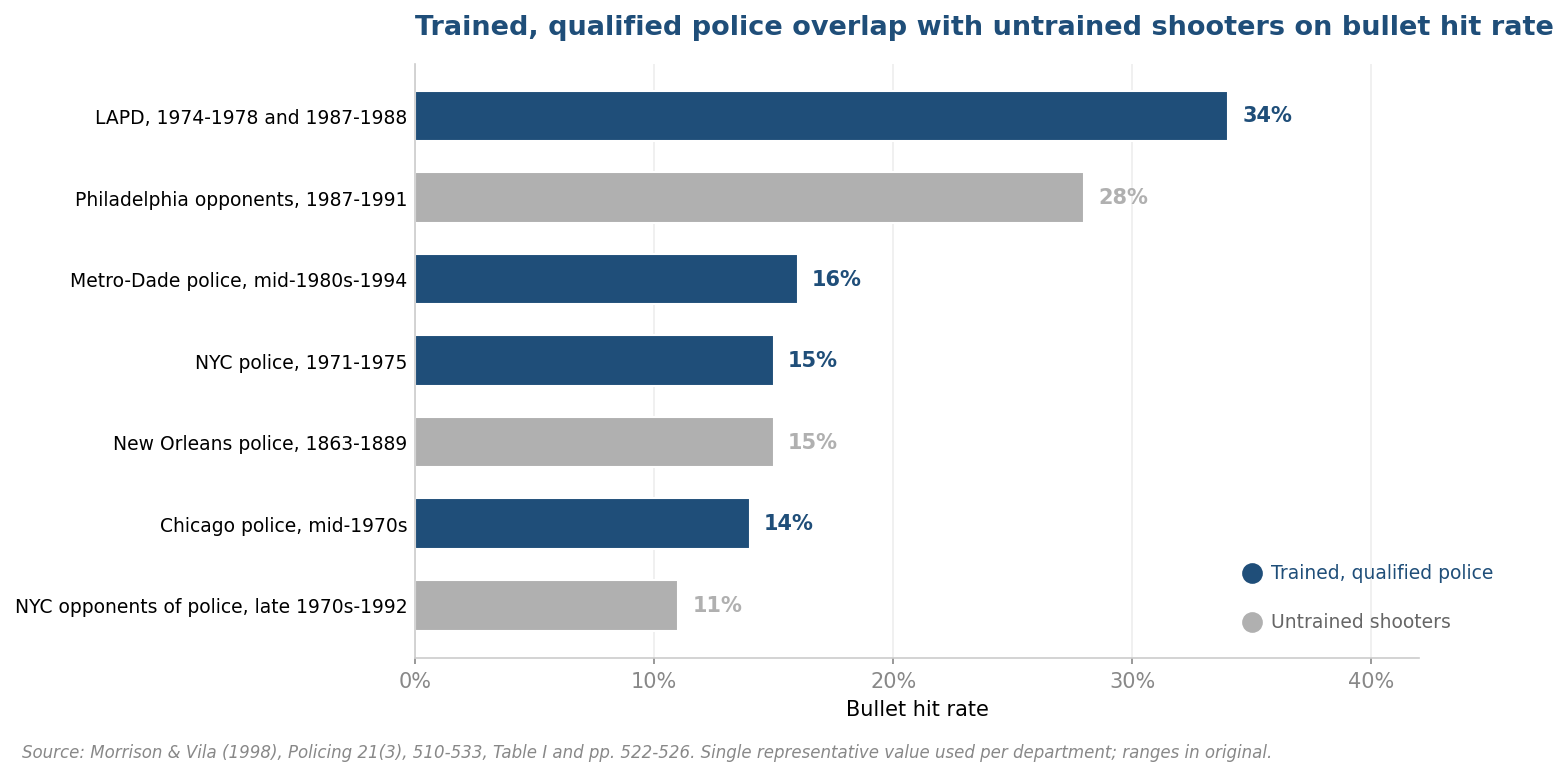
The shooting numbers tell the same story. Roussey’s nineteenth-century New Orleans police, who received no training at all, hit no more than one-third of the people they fired at, and roughly 15% of their bullets struck the intended target. A century later, the people shooting at the police (presumed untrained) hit officers about 10-12% of the time in New York City across the late 1970s through early 1990s, and 28% of the time in Philadelphia between 1987 and 1991. Roughly 14% of New York officers struck by opponent gunfire between 1970 and 1991 died of their wounds, similar to the 14% fatality rate among civilians fired upon by nineteenth-century New Orleans police.
The trained contemporary officers do better, but not dramatically. Bullet hit rates from departmental studies range from 14% (Chicago, mid-1970s) and 15-17% (NYC across the 1970s through 1992) up to 30-38% (Los Angeles, 1974-78 and 1987-88). Metro-Dade sat at 16% from the mid-1980s through 1994. Incident hit rates, which count whether any bullet hit anyone, varied from 27% (Chicago mid-1970s, NYC late 1980s) to 59-60% (Philadelphia and Dallas, late 1980s). Person hit rates ran from 22% to 56% across multiple cities. Fatality rates among opponents struck by police bullets clustered around 26-31% across most cities studied, with Dallas (39%) and Los Angeles (38%) somewhat higher.
Morrison and Vila lay these next to each other and the lower end of the trained-officer distribution lands on top of the untrained baselines. Chicago’s 14% bullet hit rate is basically Roussey’s 15% for the untrained New Orleans force. NYC’s 15% bullet hit rate in 1971-75 is the same number.
The single direct test of the qualification-to-field link they could find is the most damning piece. Alpert’s Metro-Dade study (1989, cited by Geller and Scott 1992) reports “no relation between shots fired that hit their targets and the officer’s qualifying score.” McGee, then chief firearms instructor for the NYPD, examined 1970s field shootings and could not find a “clear connection” between range scores and bullet hit rates either. Two departments looked, two found nothing.
So What?
The authors’ own conclusion is that qualification, as American departments practice it, is not a valid measure of gunfighting ability. It tests an officer’s capacity to shoot a fixed number of rounds at a clearly defined target at a known distance, with set time limits, and clear an arbitrary threshold. None of that mirrors what happens in an armed confrontation, and none of the prevailing doctrine, technique, or threshold-setting was developed by looking at field-shooting data or evaluated against it after the fact. Their words: “the rote firing of time-honored courses and their derivatives produces well-practiced range marksmen, but it does not assess their ability to perform in gunfights.”
They are explicit about the limits of their comparison. The data come from different cities, different time periods, and different reporting conventions; departments do not always report the n behind their aggregate figures; nineteenth-century New Orleans is one department and may not represent that era; contemporary opponents’ marksmanship is confounded by impairment, exertion, and unknown levels of resolve. They treat the comparison as suggestive, not definitive, and say so.
The implications they draw: officer safety improvements over the late twentieth century are more plausibly attributable to soft body armor and better field tactics than to better marksmanship; the field needs a research program rather than further hardware-driven tinkering. They recommend developing a taxonomy of training doctrines, standardizing measurement of field shooting accuracy across departments, building a general theory of police gunfighting that training goals can be derived from, running quasi-experiments using scripted scenarios and computer simulations, and routinely evaluating training programs and feeding results back to instructors. They want practitioner organizations (ASLET, IALEFI) to host joint academic-practitioner work. They close by saying that until departments do this, validation will remain elusive and qualification will remain “a misleading and aimless activity.”
My $.02
This is an older paper, but I like it because it documents that the qualification/field performance gap is not a new issue. I also like the historical overview.
The data here and in other places suggest that firearms qualification does not relate to performance in the field. In science terms, firearms qualification is not a valid measure of field shooting performance.
This is not surprising given that this is a case of far transfer. Meaning that we are practicing something very different from the thing people are expected to do in the field. The research here is very clear and consistent. Far transfer essentially does not exist. Some of my firearms trainer audience is already grumbling, but let me explain.
In the field, an officer must interact with people, use movement and spacing to keep a tactical advantage, attempt to de-escalate, decide that force is needed, implement that force in a way that is effective and legal, assess the outcome, alter course if needed, and then deal with the aftermath.
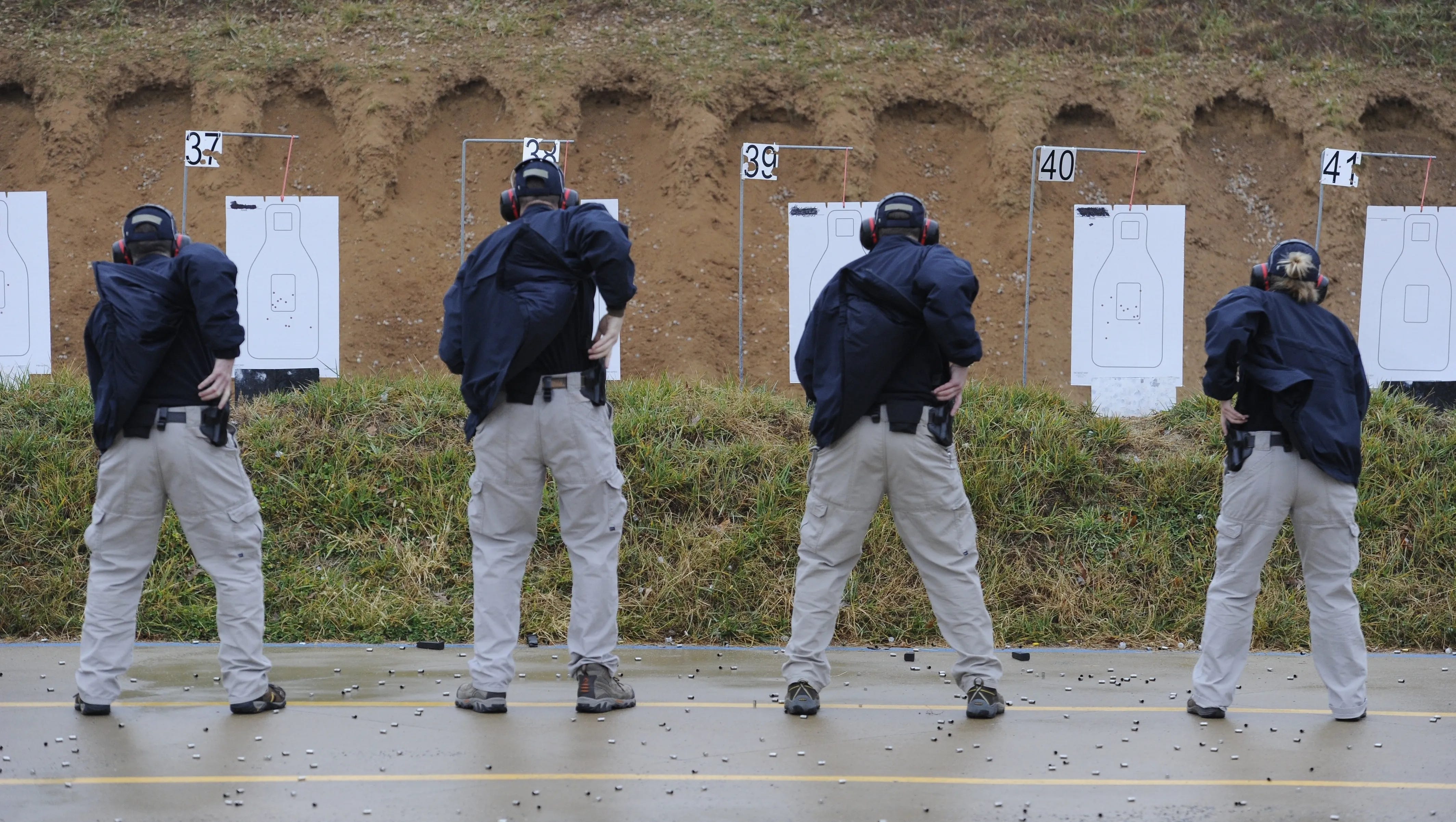
On the range, a trainee hears a timer beep or sees a target turn, and then fires a set number of shots at a piece of paper, which often only vaguely looks like a person, in a certain amount of time. Then they have to swivel their head because maybe the instructor is walking behind them holding up a random number of fingers.
You should be able to see that while a gun is used in both environments, the perceptual cues that control the use of that gun and the actions surrounding that use are very different. As I have discussed in depth here before, perception and action are so intimately linked that if you change the perceptual cues, you automatically change the action. This means if you are not practicing with cues that are close to the real thing, then the actions you practiced will not show up in the field.
For those who are interested, I have published other posts on this at the links below
You Call That “Expert” Shooting?
Police Shootings Aren’t Scripted—So Why Is Our Training?
The uncontroversial core of all of this is that if you want to get good at something, you should practice that thing. If that is true, why do we keep trying to get good at something by practicing something else?
A qualification Score each year helps to set the ground work for trainers who identify officers that need more training in the basics. Those may be identified by testing the officer on a bullseye target at 7 and 10 yards. Just using 10 rounds, anything outside of the black circle needs to be addressed until the problem is fixed. You firearms instructors know what Im talking about.
once that's addressed start the tactical movement, cover, tactical reloading, night fire exercises, etc.
Testing with the bullseye target during each qualification for seasoned and new officers is a must.
seasoned officers have a tendency only be concerned about their marksmanship during a qualification. When actually the range should be available. I go to the range several times a month, even though retired, to shoot several the Schreck McPhee drills.
Stay Safe Out There!
Agree with all you said. Would add: gunfight opponents often move. Stationary targets of course do not. Until somebody develops an affordable way to make a target jump up and down and to the side , range training will continue to be only mildly helpful